- Home
- China
- World
- Asia-Pacific
- Americas
- Europe
- Middle-East and Africa
- Politics
- Business
- Opinions
- Tech & Sci
- Culture
- Sports
- Travel
- Nature
- Picture
- Video
- Live
- TV
- Specials
- Learn Chinese


Share







Copied

Hypothermia is one of the biggest challenges of outdoor activities. /CFP
A cross-country mountain marathon in northwest China's Gansu Province has turned into a public safety incident as 21 competitors died from hypothermia after being hit by extreme weather, according to local authorities.
Hypothermia, or simply loss of heat, is one of the biggest challenges of outdoor activities.
Generally speaking, hypothermia happens when human body loses heat faster than it generates. It will cause a series of symptoms like shivering, confusion, and cardiopulmonary failure, and even eventually lead to death.
Hypothermia can be mainly divided into three stages, according to Liu Gang, former captain of China International Search and Rescue.
Mild hypothermia (core body temperature of about 37 to 35.5 degrees Celsius) can cause shivering and the inability to make complex movements, but one can still walk and talk.
"If mild hypothermia takes place when one is in a complex terrain, mountain climbing, or other conditions that are physically demanding during the cross-country race, it will lead to action deformation, causing the participant to fall off the cliff, trip by the stone, or fall into a deep pit," said Liu.
As hypothermia worsens to a moderate stage (core body temperature of about 35 to 33 degrees Celsius), one will experience lower level of consciousness, lack of coordination, slurred speech, violent shivering, and abnormal behavior.
At a severe stage (core body temperature of about 33 to 30 degrees Celsius), one will be presented with pale or blue, swollen skin, loss of consciousness, decreased heart rate and blood pressure, partial or complete loss of speech, persistent and violent shivering developed to intermittent shivering with longer and longer intervals, and finally no shivering any more.
The most common reason for hypothermia is exposure to cold environment. But as the human body is a pyrogen, it carries out heat transfer with the outside world at anytime and anywhere. There's also risk of hypothermia in summer.
Temperature, humidity and wind are the most common factors leading to hypothermia.
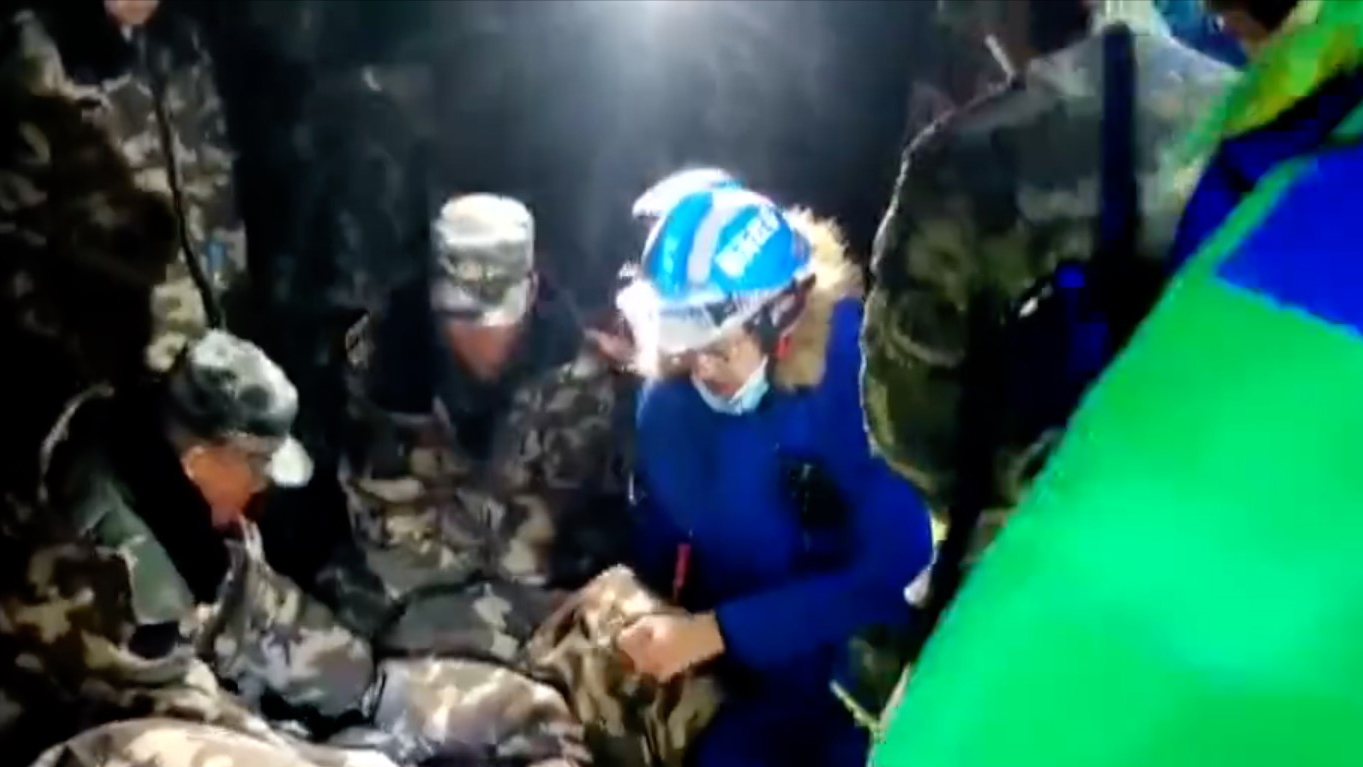
According to the local rescue headquarters, at about 1 p.m. on Saturday, hail, freezing rain and gales hit the area of the race's high-altitude stage between 20 to 31 kilometers. Participants suffered from hypothermia due to the sudden drop in air temperature.
"Participants in the cross-country running sweat a lot, and then exposed to a certain level of wind and humidity in the harsh environment. Their body consumed a lot of heat without sufficient heat preservation, resulting in the drop of core body temperature. Then hypothermia symptoms occur," said Xu Hao, a researcher with Jiangsu Research Institute of Sports Science.
Preventive measures
Here are some tips you may need to fend off hypothermia:
Choose underwear that dries quickly and wicks sweat. Do not choose cotton ones as cotton fabrics absorb sweat rather than repelling it, which may result in temperature loss.
Wear a light, quick-dry T-shirt or a breathable jacket before hiking in a high and cold area, but put on warm clothes gradually.
Take appropriate measures and not be exposed to cold winds. Take hats, gloves, scarf, windbreaker, thick socks, and a wind mask when traveling in windy and cold weather.
Prevent dehydration, excessive sweating and fatigue. Prepare food and hot drinks for replenishment.
Once hypothermia symptoms occur, the priority is to try to avoid further heat loss and avoid exposure to the cold environment. Keep your body warm, especially the core parts such as neck, armpits, and groin.
Be careful not to give hot water or wine to people with severe hypothermia, as that can dilate blood vessels, leading to hypotension and further lower one's core body temperature.
