- Home
- China
- World
- Asia-Pacific
- Americas
- Europe
- Middle-East and Africa
- Politics
- Business
- Opinions
- Tech & Sci
- Culture
- Sports
- Travel
- Nature
- Picture
- Video
- Live
- TV
- Documentary
- Radio
- Specials
- Learn Chinese


Share







Copied
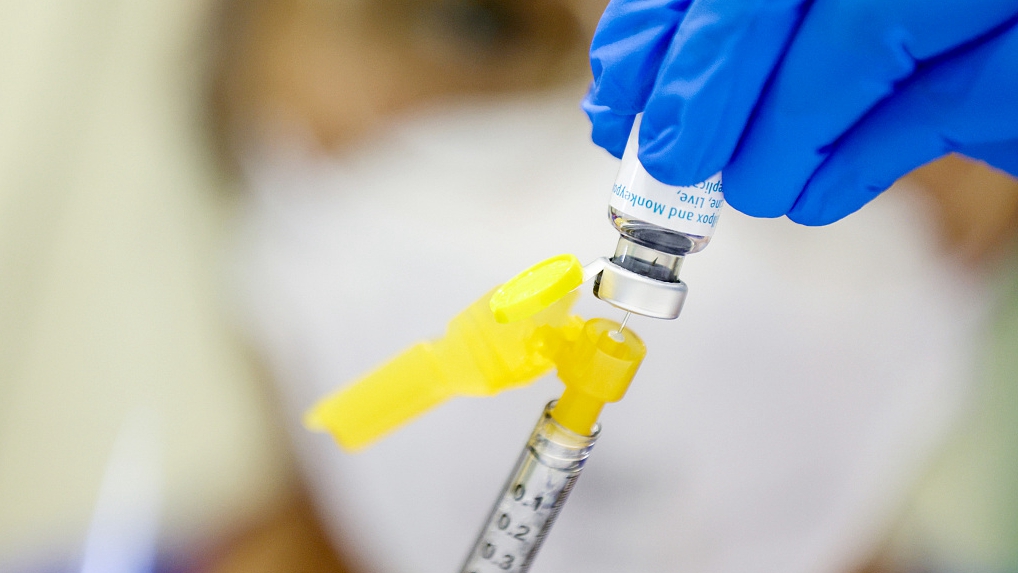
A nurse prepares a dose of monkeypox vaccine at an L.A. County vaccination site in East Los Angeles, August 10, 2022. /CFP
The number of monkeypox cases reported globally dropped by 21 percent in the last week, reversing a month-long trend of rising infections and signaling that Europe's outbreak may be starting to decline, the World Health Organization (WHO) said Thursday.
The UN health agency reported 5,907 new weekly cases and said two countries, Iran and Indonesia, reported their first cases. To date, more than 45,000 monkeypox cases have been reported in 98 countries since late April.
The Americas accounted for 60 percent of cases in the past month, the WHO said, while cases in Europe comprised about 38 percent. It said infections in the Americas showed "a continuing steep rise."
At a press briefing on Thursday, WHO Director-General Tedros Adhanom Ghebreyesus said although there were indications the monkeypox outbreak was slowing in Europe, which once accounted for 90 percent of the world's lab-confirmed cases, the spread of the virus was now causing concerns elsewhere.
"In Latin America in particular, insufficient awareness or public health measures are combining with a lack of access to vaccines to fan the flames of the outbreak," Tedros said.
In late July, Tedros declared the unprecedented spread of monkeypox to dozens of countries to be a global emergency, despite a lack of consensus on his expert committee.
Since monkeypox outbreaks in Europe and North America were identified in May, the WHO and other health agencies have noted that its spread was almost exclusively in men who have sex with men.
Monkeypox has been endemic in parts of Africa for decades and experts suspect the outbreaks in Europe and North America were triggered after the disease started spreading via sex at two raves in Spain and Belgium.
The WHO's latest report said 98 percent of cases are in men and of those who reported sexual orientation, 96 percent are in men who have sex with men.
The WHO has recommended that men at high risk of the disease temporarily consider reducing their number of sex partners and refraining from group or anonymous sex.
Monkeypox typically requires skin-to-skin or skin-to-mouth contact with an infected patient's lesions to spread. People can also become infected through contact with infected clothing or bedsheets.
(With input from AP)

Search Trends
Copyright © 2020 CGTN. 京ICP备16065310号

Disinformation report hotline: 010-85061466
Copyright © 2020 CGTN. 京ICP备16065310号
Disinformation report hotline: 010-85061466
Copyright © 2020 CGTN. 京ICP备16065310号
Disinformation report hotline: 010-85061466