
Share







Copied
The Chinese government has been stressing the vitality of high-quality development in recent years, which entails obvious improvements to the quality and efficiency of economic development, such as quality of the working force, innovation, new technologies, global competitiveness of industries, products and services, and so on.
On Sunday's State Council study session, Premier Li Qiang underscored it again, saying high-quality development is an intrinsic requirement of Chinese modernization, an inevitable choice when crossing major thresholds, and the key to gaining a strategic advantage. He urged officials to make every effort to promote high-quality development.

A college graduates exchange meeting is held in a college of Nantong City, east China's Jiangsu Province, January 12, 2020. /CFP
Turning population dividend into talent dividend
It's not a coincidence that the Chinese government is repeatedly underscoring the importance of high-quality development and it's the inevitable result of economic development, according to economists.
In China, decades of urbanization has greatly enlarged the urban population to 64.7% at the end of 2021, and reduced the supply of migrants from the countryside. The process is accompanied by rising urban wages, improvement of education levels, technological innovation and enhanced quality of products, services and industries.
On Wednesday, data from the UN projected that India is to surpass China as the world's most populous country by mid-2023, and some voiced that China's population dividend is disappearing. However, Think tank experts and economists say China maintains its advantage for high-quality development based on its volume of high-level talent and the country's investment in talent cultivation. And the country is turning the population dividend into talent dividend.
"When assessing demographic dividend, we shall not just look at the sheer size of the population, but also look at the scale of the high-caliber workforce,” Premier Li Qiang said in March while addressing the media after he took office.
National statistics show that China has a population of more than 1.4 billion. And, currently, almost 900 million people in China are of working age, with more than 15 million new workers joining the labor force each year. In addition, China's population with higher education has exceeded 240 million, and the average length of education for the new workforce has risen to 14 years.
Premier Li believed that the talent dividend will provide a strong impetus for China's high-quality development.
Read more: China's talent dividend is in the making, key drivers of development remain robust
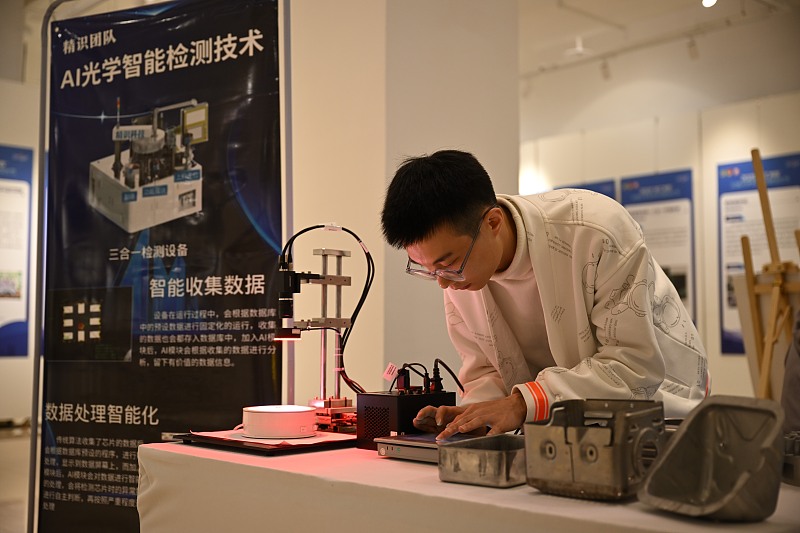
A college-student technological works exhibition is opened at Southwest University, Chongqing Municipality, April 6, 2023. /CFP
What benefits will talent dividend bring to China?
His remark is corroborated by the entrepreneurial experience of Fan Hongjing, who owns a tea business in his mountainous hometown Liupanshui, in southwestern China's Guizhou Province. The annual sales of his tea company rose to 12 million yuan in 2021, up from only 8 million in 2020 and 4 million in 2019.
The man graduated from Wuhan University in 2009, a prestigious college in China and then worked in a securities company with a good income. After years of working there, he decided to start a business in his home village, which got strong disapproval from his father, who believed that his son should not waste his life in the village as he is highly educated.
However, by using his expertise and talent, Fan got his first pot of gold by planting tea in the village and then he expanded the scale and efficiency of the tea factory by introducing talent and technology and improving the management system. His factory not only makes him achieve economic independence, but helped local villagers get employed, attracted many college students to work for him and boosted the establishment and development of upstream and downstream enterprises.
Just like Fan, more and more young talents are returning to their countryside hometowns to start businesses, and many are going back to their hometowns to get employed after they graduated from universities in first-tier cities, like Beijing and Shanghai, which experts say will boost the rural revitalization, balanced regional development and bring a new consumption model to less-developed regions.
Cheng De'an, a professor at the Southwest University of Political Science and Law said that the shortage of talent has always hindered the development of less-developed regions, while people with high education levels usually have a stronger professional ability, rich practical experience, and can make better performance in creativity, innovation, and decision-making, so their return will boost the development of these less-developed regions.
A 24-page report by KPMG China, a multinational accounting company shows that although China's population growth is slowing down, the population flow and population quality improvement are speeding up.
The changing population structure will boost the development of the silver economy, as well as single-person, infant and pet consumption. Besides, the growth of the younger generation of consumers will provide a huge space for the rise of Chinese brands in the following 10 years. And automation and intelligent upgrading will also be accelerated, the report said.
"We believe that China's talent dividend will gradually release, and accelerate the transformation of economic development pattern, promote the upgrading of industrial structure and provide support to China's high-quality development," read the report.
Read more:
China's talent dividend drives high-quality development: expert
CGTN Poll: The 'talent dividend' has become a strong impetus for China's development
Search Trends
SITEMAP
Copyright © 2023 CGTN. 京ICP备16065310号

Disinformation report hotline: 010-85061466
SITEMAP
Copyright © 2023 CGTN. 京ICP备16065310号
Disinformation report hotline: 010-85061466