
Share







Copied
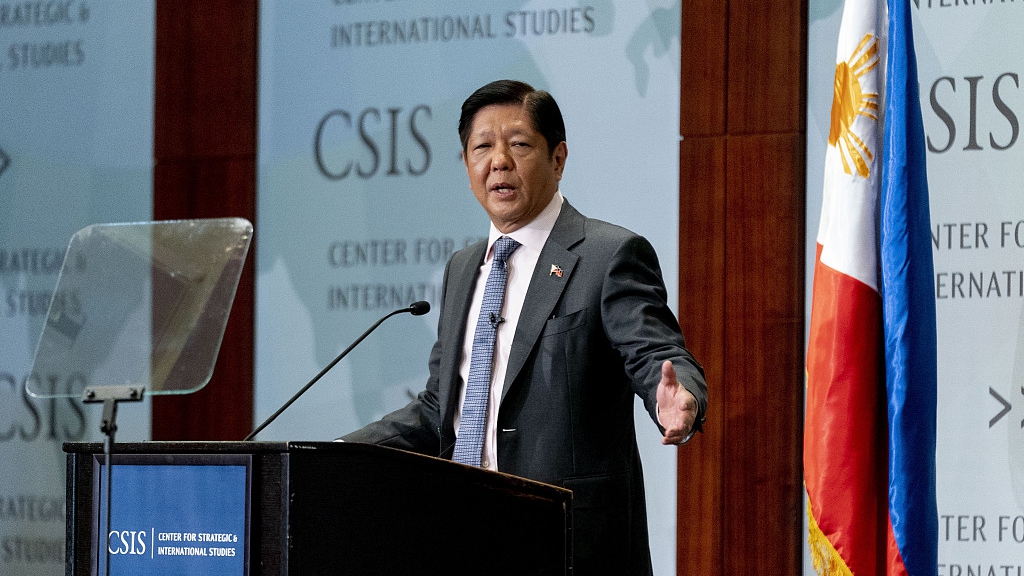
Philippine President Ferdinand Romualdez Marcos Jr. speaks at the Center for Strategic and International Studies in Washington, D.C., U.S., May 4, 2023. /CFP
Philippine President Ferdinand Romualdez Marcos Jr. said on Thursday the U.S. can't use military bases in his country for "offensive action" against China in the event of a future military conflict over the Taiwan region.
Marcos made a speech at the Center for Strategic and International Studies in Washington D.C., saying that the 2014 Enhanced Defense Cooperation Agreement (EDCA) that allows access to bases in the Philippines was conceived to deal with the effects of climate change.
Marcos said he told U.S. President Joe Biden the military bases are not intended to attack anyone, or any country, including China.
He said use of EDCA bases for "offensive action" would be outside the parameters of what Manila had discussed with the U.S. and added that the U.S. had never brought up the possibility that they would be used as "staging areas" for offensive action against any country.
Manila's ties with Washington have deepened under Marcos and he granted the U.S. military access to four more military bases in February.
U.S. Defense Secretary Lloyd Austin said after a meeting of the defense and foreign ministers of the U.S. and the Philippines last month that it was "too early" to discuss what assets Washington would like to station at Philippine bases.
Marcos came to Washington D.C. for a summit with Biden seeking clarity on the extent of the U.S. commitment to protect his country under a 1951 security pact, amid rising tensions in the South China Sea.
Biden said after their meeting on Monday the U.S. commitment to the defense of its ally was "ironclad," including in the South China Sea.
Chinese Foreign Ministry said on Thursday that the South China Sea is the common home of regional countries and should not become a "hunting ground" for forces outside the region.
(With input from Reuters)
Search Trends
SITEMAP
Copyright © 2023 CGTN. 京ICP备16065310号

Disinformation report hotline: 010-85061466
SITEMAP
Copyright © 2023 CGTN. 京ICP备16065310号
Disinformation report hotline: 010-85061466