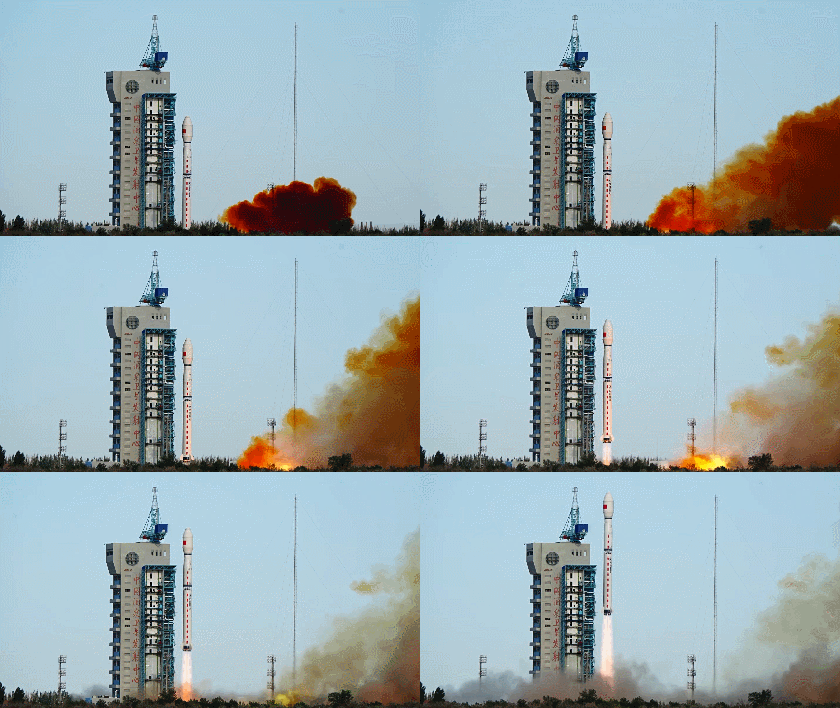
A Long March-4B rocket, carrying the Haiyang-2E satellite, lifts off from the Jiuquan Satellite Launch Center, July 2, 2026. /CMG
China on Thursday launched a new satellite for ocean monitoring from the Jiuquan Satellite Launch Center in northwest China.
A Long March-4B rocket, carrying the Haiyang-2E (HY-2E) satellite, blasted off at 7:46 a.m., and successfully sent the satellite into the preset orbit.
Developed by the China Academy of Space Technology, the satellite will be mainly used for safeguarding maritime rights and interests, disaster prevention and mitigation, marine resource development, and marine scientific research.
It will replace the HY-2B satellite, launched in 2018, and operate as part of a satellite network with the in-orbit HY-2C and HY-2D satellites to ensure the continuous and stable operation of China's marine dynamic environment monitoring system.
The satellite features upgraded payload technology, significantly enhancing its observational capabilities in nearshore waters.
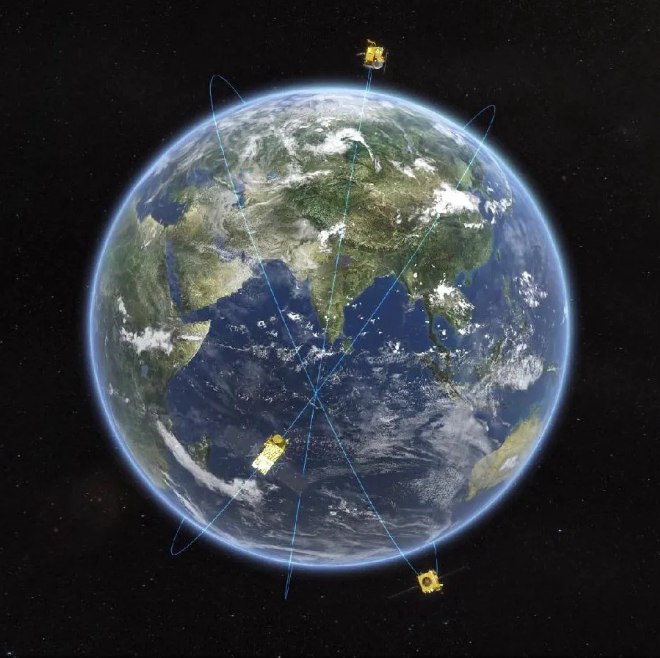
Rendering of the HY-2 satellite constellation. /China Academy of Space Technology
The carrier rocket, developed by Shanghai Academy of Spaceflight Technology, is a three-stage liquid-propellant launch vehicle capable of deploying various types of satellites to different orbits.
It can carry either single or multiple satellites per mission, with a payload capacity of 2.5 tonnes to a sun-synchronous orbit at an altitude of 700 kilometers.
The launch marks the 654th flight mission of the Long March carrier rocket series.