
China Pulse
14:38, 08-Apr-2019
Wish you were the one
Updated
14:49, 08-Apr-2019
 ["china"]
Share







Copied

"No one's willing to drift or reject a warm home, but reality doesn't always conform to expectations," said Yue, a 27-year-old editor based in Beijing. The cheery young woman is one of the 200 million singletons in today's China.
The latest statistics from the National Bureau of Statistics and the Ministry of Civil Affairs show that the country's marriage rate has been in decline for five consecutive years from 9.9 per 1,000 in 2013 to 7.2 per 1,000 last year. What's more notable is that the more developed the region, the lower the marriage rates.
Shanghai and Zhejiang along the affluent east coast, which ranked the second and fifth in GDP per capita, registered rock-bottom marriage rates: 4.4 and 5.9 per 1,000 respectively in 2018. The figures in Beijing, Tianjin and Guangdong were also quite low.
In the meantime, Guizhou Province, crouched in the southwestern hinterland of the country, where GDP per capita ranked third from the bottom, witnessed the highest marriage rate at 11.1 per 1,000. The Tibet Autonomous Region, Qinghai, Jiangxi and other less developed places were also among the regions going through the highest marriage rates over the past few years.
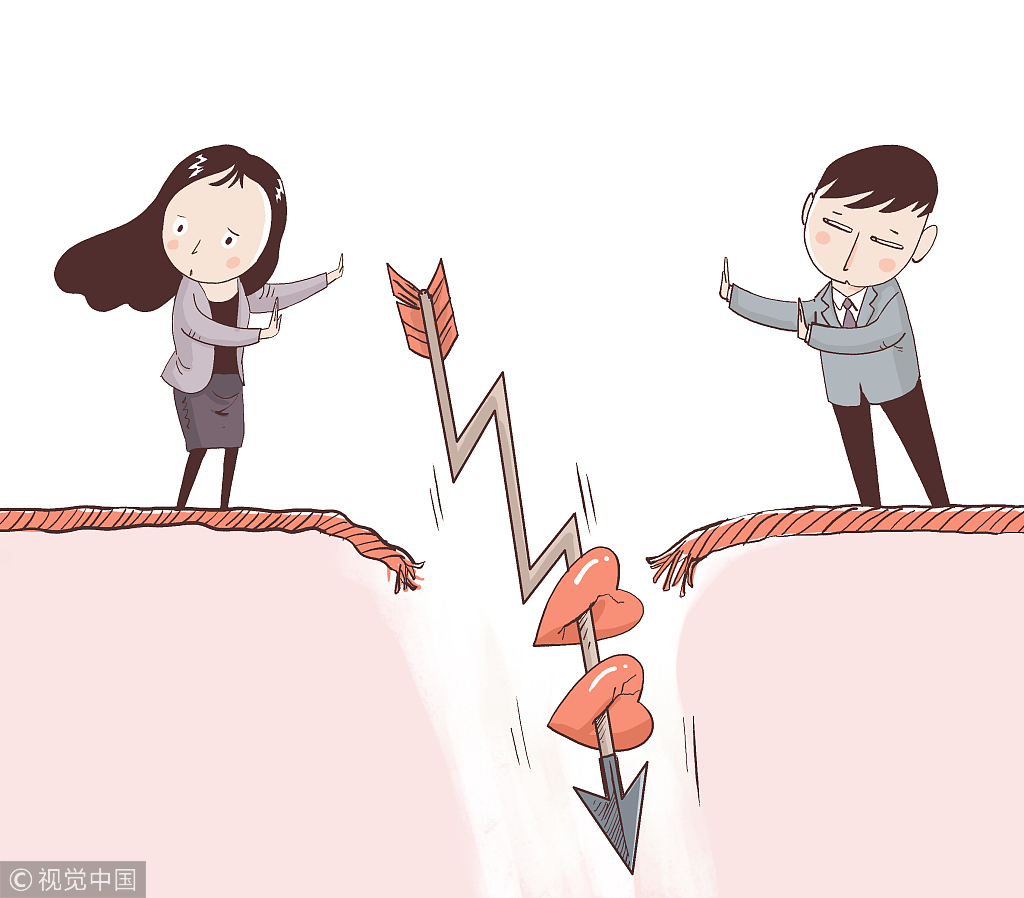
VCG Photo
VCG Photo
Entry into marriage has taken on an inverse relation to a region's economic growth and individual income. Statistics also show that Chinese millennials are in the lead when it comes to divorce. In 2018 alone, 3.8 million married couples broke up, nearly 110,000 more than the previous year.
"We saw a divorce-to-marriage ratio of 38 percent in 2018. The figure culminated in a staggering 60 percent in Beijing and exceeded 50 percent in Shanghai," said Li Yinhe, professor with the Institute of Sociology at the Chinese Academy of Social Sciences, during an interview with CGTN.
Only eight years ago the ratio was 16 percent. Apart from changing demographic structures and an aging population, Li – a pioneer in gender studies – views the lower marriage rate and the higher divorce rate as a concomitant phenomenon of China's transformation from traditional conformity to luxuriant modernity.
The soaring housing and child-rearing costs in relatively developed metropolises discourage young lovers from starting a family, and also prompt people to assess the material value of their dates on their first meeting. "I've had enough of it," said Yue, who's in a WeChat group focusing on blind dating where the parents of young men are often upfront about their materialistic demands.

VCG Photo
VCG Photo
Owing to urbanization, women are receiving greater education and financial independence, reducing their dependence on men in marriages. The economic arrangement in modern society has already gone beyond the family-centric model rooted in the agrarian economy. Mass industrialization and machinery gave more women access to similar job opportunities available to men.
In many ways, women are more suited to the types of work of the modern era. As such, they tend to be repulsed by the "small miseries of domestic and private life" as penned by German philosopher Karl Marx.
"Those who are willing to tie the knot are warriors," said a netizen on Weibo, the Chinese equivalent of Twitter. And most female users responded to the record low marriage rate with a rhetorical question: Why should I get married when my soul mate has not yet appeared?
A report released this March showed that in 2018, women accounted for 49.7 percent of home buyers – the figure stood at 30 percent back in 2014. Among these female buyers, 74.2 percent said they did not receive financial assistance from their partners and 29 percent made the purchase completely on their own. It seems that economic security is playing a waning role in today's marriage.

Pioneer feminist Florence Luscomb speaks at Radcliffe College, Cambridge, Massachusetts, 1971. /VCG Photo
Pioneer feminist Florence Luscomb speaks at Radcliffe College, Cambridge, Massachusetts, 1971. /VCG Photo
The decline of marriage in China's well-off regions is, in a sense, social progress. Marriage rates have been in a downtrend in developed countries around the world for half a century. Only a half of American adults walk down the aisle now, a sharp drop from 72 percent in 1972. In France, the recorded marriage rate declined by nearly 50 percent between the 1950s and 1980s.
Those countries have also seen rising divorce rates in recent decades. In the United States, it started surging in the 1960s, peaking around 1980, the highest since the Centers for Disease and Control started collecting data shortly before 1870. Interpretations abound; for instance, the climb in divorces in the '60s coincided with the rise in the feminist movement in much of the West during that period.
More women started joining the workforce, taking on opportunities previously available only to men. Overall, it seems a newfound sense of female autonomy, economic independence and educational attainment have decoupled them from relying on the traditional family unit.
As the conditions surrounding modern marriages have changed, marriage itself is considered a luxury in today's world. It's difficult to maintain a contemporary marriage now without love. Li Yinhe, however, noted that love can be fickle, which could partly explain why developed regions registered a higher divorce rate, as urbanites tend to get married out of love. Meanwhile, in rural China, a number of people still marry more out of economic concerns.
"It's not that we are abandoning the norm of marriage; it's that we are still seeking true love, the one who can be our best friend," Yue told CGTN.