
Opinion
11:40, 20-May-2019
U.S. trade provocation aimed at monopolizing global market
 ["china"]
Share







Copied
Editor's Note: This is an edited translation from an editorial originally published in Chinese on www.qstheory.cnon May 18.
Recently, the U.S. government has not only provoked trade frictions against China, but also waged attacks on its allies. International trade is supposed to be mutually beneficial and there is no winner in a trade war. Given this, why does the U.S. government insist on trade provocations?
For the U.S. government, trade frictions serve the dual purpose of protecting the domestic market and expanding access to foreign markets.
Since the first quarter of 2018, the U.S. government has imposed trade sanctions on Belgium, Colombia, Thailand, Canada, South Africa, Ukraine, China, India, the ROK, Greece and Turkey.
According to statistics from Global Trade Alert, from the 2008 financial crisis to August 2018, the U.S. carried out about 1,700 trade interventions, ranking first in the world.
Countries affected by these interventions are all over the world. Canada, China, Germany, Japan, Italy, the Republic of Korea (ROK), France, the United Kingdom and Mexico were among the worst hit.
The purpose of provoking trade frictions is two-fold: one is to protect the domestic market; the other is to expand access to and dominate foreign markets through trade sanctions, thereby monopolizing the global market under the doctrine of "America First."
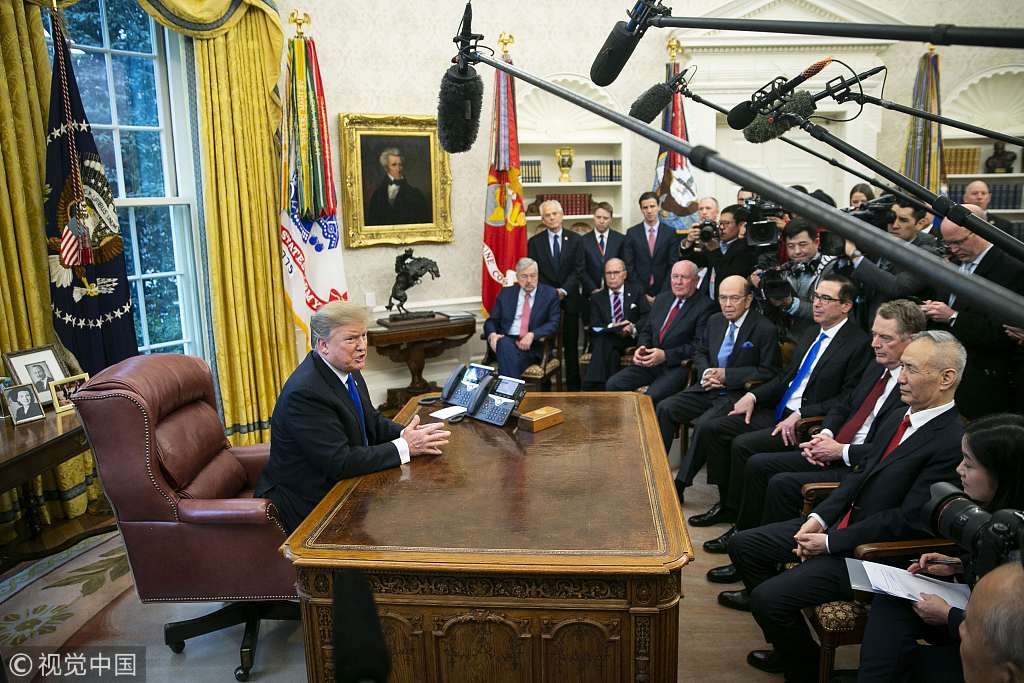
U.S. President Donald Trump (L) speaks during a meeting with Liu He, China's vice premier, in the Oval Office of the White House, Washington, DC, February 22, 2019. /VCG Photo
U.S. President Donald Trump (L) speaks during a meeting with Liu He, China's vice premier, in the Oval Office of the White House, Washington, DC, February 22, 2019. /VCG Photo
Since 2017, the U.S. has imposed additional tariffs on products from China, Canada, Argentina, Indonesia, Australia, Brazil, Norway, Mexico and many other countries. For example, 292 percent anti-dumping and countervailing duties have been levied on more than 100 large passenger planes imported from Canada.
In addition, the United States has unilaterally torn up regional trade agreements one after another. For example, the Trump administration announced that the Trans-Pacific Partnership (TPP) would deal a fatal blow to U.S. manufacturing and decided to withdraw from it.
The U.S. also unilaterally proposed to renegotiate the U.S.-ROK free trade agreement. The U.S. government's domineering behaviors featuring high tariffs and backtracking on trade agreements aim to keep trade partners away from its domestic market.
Meanwhile, the U.S. threatened to impose additional tariffs to force trade partners to open their markets to the United States. For example, it claimed that imports of steel and aluminum products were weakening its economy and threatening national security.
On March 8, 2018, the U.S. invoked Section 232 and imposed 25 percent and 10 percent tariffs on steel and aluminum products from almost all trade partners. However, the ROK was exempted when it made concessions such as increasing the annual export quota of U.S. cars to the ROK from 25,000 to 50,000.
Subsequently, other countries and regions that made concessions to the United States were also exempted, while countries that refused to give way were subject to tariff increases. In this way, the U.S. was on a winning streak by wielding the stick of tariffs to knock open markets of other countries.

Chinese-made hats are displayed for sale at a Manhattan department store in New York City, U.S., May 7, 2019. /VCG Photo
Chinese-made hats are displayed for sale at a Manhattan department store in New York City, U.S., May 7, 2019. /VCG Photo
In fact, the current U.S. bullying strategy is nothing more than a replay of what it did in the past. From the 1970s to the 1990s, due to the rising trade deficit with Japan, the United States constantly provoked trade frictions by imposing trade restrictions on Japan, forcing Japan to limit its exports to the United States through political pressure, and forcing Japan to further open its domestic market to the United States by invoking Section 301.
In the 1990s, due to the EU's restrictive policy on banana imports, the share of major American banana export companies dropped significantly. So Washington threatened to levy 100 percent retaliatory tariffs on EU goods to force the EU to make concessions and resume imports of banana.
However, with the development of economic globalization and political multi-polarization and the rise of emerging economies represented by China, it is not difficult for a slightly rational person to see how far this crude and blunt hegemonism and unilateralism can go.
By provoking trade frictions, the U.S. aims to compete for and expand access to the global market and grab huge profits from it. However, the world is in a period of unprecedented development marked by great changes and adjustments. The market economy is booming in many countries and the global market is getting saturated.
Under such circumstances, American policymakers are reluctant to lose in the market competition. They believe a full-blown trade war is the simplest, quickest and most effective way to protect the domestic market and occupy foreign markets, and that there is no way they will lose.
These self-righteous politicians are ramping up trade barriers and closing their own market while trying to knock open the markets of other countries by resorting to a trade war.
Therefore, however the U.S. justifies its foreign trade policy, its ultimate purpose is competing for and dominating the limited global market. The trade war waged by the U.S. is not an accidental trade phenomenon; it's a way to monopolize the global market through "maximum pressure."
Economic globalization is the trend of the times. Hindering globalization for the benefit of monopolistic capital is against the trend.
China, on the one hand, must follow the historical trend of globalization, continuously deepen reform, open wider to the outside world, and promote and guide the healthy development of globalization. On the other hand, in the face of the anti-globalization movements, China should be ready to fight a protracted war with "adventurers" like American politicians.
(If you want to contribute and have specific expertise, please contact us at opinions@cgtn.com.)