
Opinion
21:53, 19-May-2019
U.S. faces the greatest risks in trade war with China
 ["china"]
Share







Copied
Editor's note: Victor Oluoch is a journalist with Kenya's Nation Media Group and is currently participating in the China Africa Press Center 2019 program in Beijing. The article reflects the author's opinion, and not necessarily the views of CGTN.
On January 20, 2017, Donald Trump took the oath of office to be the 45th president of the United States of America with high hopes that American diplomatic policies could be revised as a win-win.
But two years later, such a thing has yet not happened and its policies surrounding foreign trade have continued to lack coherence.
Since his inauguration, what Trump has done is to chase away American friends in the name of "making America great." During his campaign against Hillary Clinton in 2016, he said that he will regain the lost glory of the U.S. Ironically, Americans will be going to the polls again next year with their country's image on the global stage taking a weird shape.
Instead of fulfilling his campaign promises of making the U.S. home for all, he has done more damage with the trade war he has waged against China. The war has helped unveil the real Trump as it stands out that everything is about him despite bragging that he is the “greatest president.”
Currently, for example, he keeps positing that the tariffs imposed on Chinese goods will improve America's economic growth when the truth is that the tit-tat tariff games will have a negative impact on both economies.
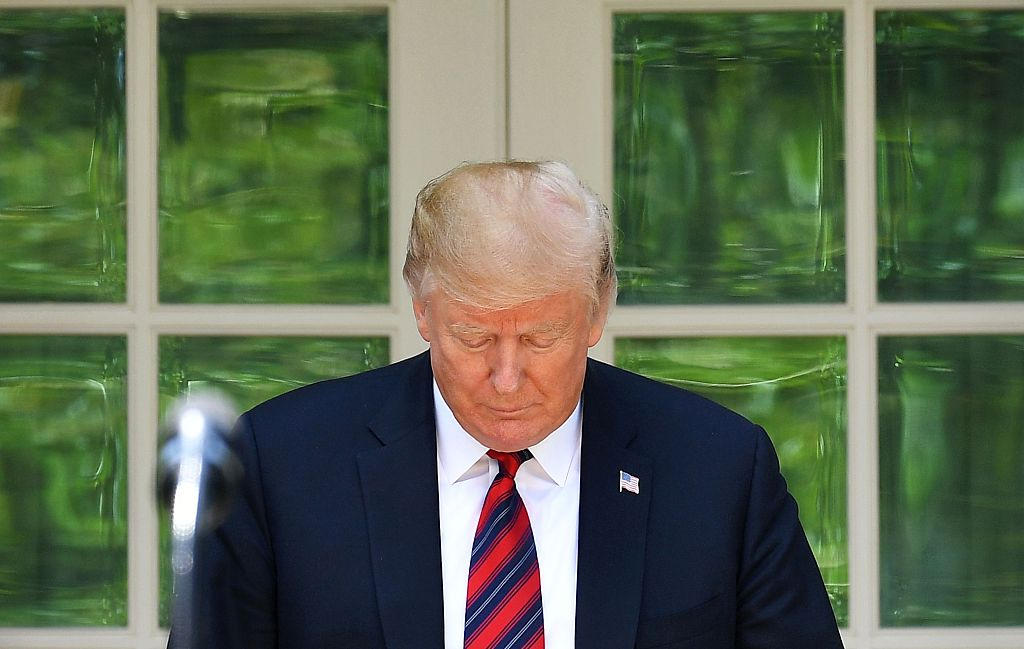
U.S. President Donald Trump looks down as he announces a new immigration proposal, in the Rose Garden of the White House, May 16, 2019. /VCG Photo
U.S. President Donald Trump looks down as he announces a new immigration proposal, in the Rose Garden of the White House, May 16, 2019. /VCG Photo
The main objective of Trump in his trade conflict with Beijing is to contain China's rise as America has never had an economic peer competitor. Its previous conflict with the USSR was fought on ideological grounds and military strength.
Interestingly, winning or losing the trade war has different requirements for each party. From Washington's point of view, to win it needs full Chinese submission. From Beijing's perspective, winning means the ability to remain standing and finding a solution acceptable for both sides. It is hard to see the latter submitting.
On the whole, the U.S. is in the unenviable position of being damned if it does and damned if it doesn't, with respect to the rise of China. Basically, Trump believes China is stealing from America.
The rhetoric around forced technology transfers is coming from the Trump administration. It should be noted that the World Trade Organization encourages developed economies to transfer technology to developing economies, of which China is one and has even proved its willingness in the matter by the adoption of its Foreign Investment Law in mid-March.
But the incessant attacks from the U.S. side on China explains its ambition to contest all kinds of domains such as technology and that is why Trump has been warning U.S. allies not to use China's tech giant Huawei.
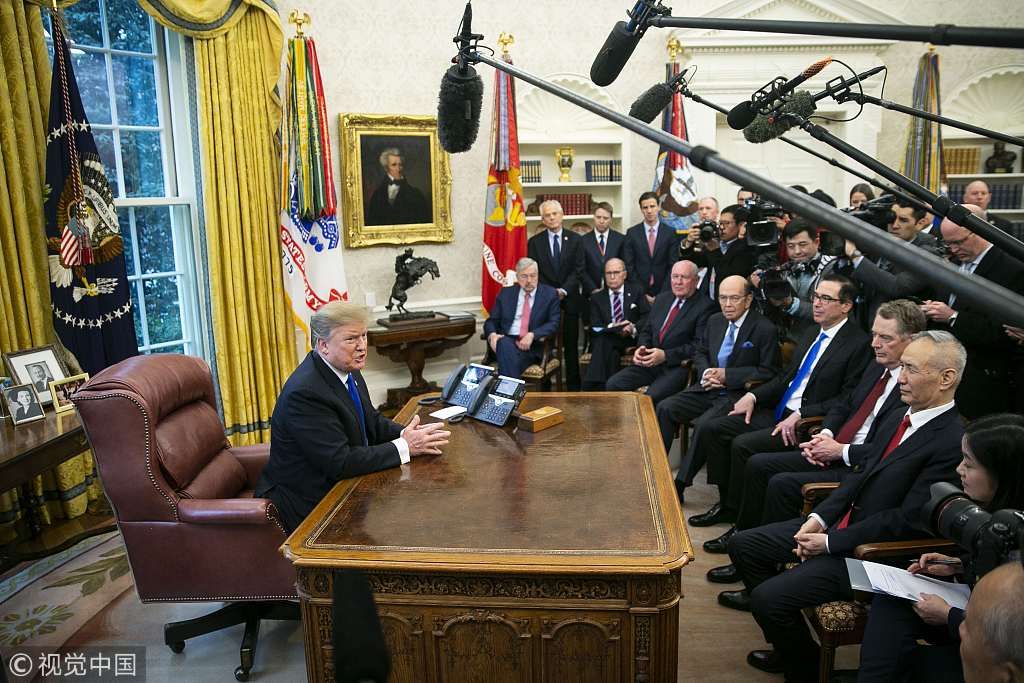
U.S. President Donald Trump (L) speaks during the trade meeting with Liu He, China's vice premier, in the Oval Office of the White House in Washington, DC, U.S., February 22, 2019. /VCG Photo
U.S. President Donald Trump (L) speaks during the trade meeting with Liu He, China's vice premier, in the Oval Office of the White House in Washington, DC, U.S., February 22, 2019. /VCG Photo
From the ongoing Sino-U.S. trade frictions, it is evident that a win-win world is not possible if the U.S. upholds the idea of a zero-sum game. Washington is in danger of creating an intriguing cold war stance which it looks like fighting alone after seeing France and Germany say they will not bring down Huawei's 5G infrastructure.
American complaints that China is cheating its way to the top by stealing technology, and also arguing that Beijing is muscling into the South China Sea, bullying democracies like Canada and Sweden, and becoming a threat to global peace, are a big fallacy which the U.S. utilizes to hide behind than accepting the reality that the time for protectionism is long gone.
Unfortunately, this trade war will continue to hurt the global economy and with the provocation and prolongation of the dispute by President Trump and his administration, as well as the likelihood of an extension of his presidency into a second term, it appears likely that the trade war will continue into the unforeseen future.
While all parties will suffer, it is the U.S. that faces the greatest risks because we have seen the European Union warning that they will negotiate limited trade deals with the U.S. Where does this leave the Trump administration? In the end, we will be faced with a permanent shift in the global order, along with the possibility of global instability for a long-term period.
(If you want to contribute and have specific expertise, please contact us at opinions@cgtn.com.)