
 []
[]
Share







Copied
Qatar's ruling emir Sheikh Tamim bin Hamad al-Thani is set to meet with U.S. President Donald Trump in Washington, D.C., on Tuesday amid the ongoing blockade which was imposed on the oil-rich state by a U.S.-backed Arab coalition two years ago.
According to Qatar's state news agency QNA, the two leaders will exchange views on the latest regional and international developments. The White House in June mentioned the visit would also deal with economic and security ties, as well as counter-terrorism issues.
When meeting with the Qatari leader on Monday, Acting U.S. Defense Secretary Mark Esper said the bilateral relationship is "stronger than ever" and praised Qatar's efforts to de-escalate the tension in the Middle East.
"Qatar's long-standing willingness to host United States' forces is emblematic of the close ties between our two countries," he added.
U.S.-Qatar relations stretch back all the way to when the countries established diplomatic ties in 1972. Qatar emerged as the United States' key partner in the Middle East since the 1990s and it currently serves as the largest host to U.S. military facilities in the region.
However, the allies didn't see eye-to-eye on some Middle East-related issues like, terrorist financing, ties with Iran and the U.S.-proposed "Deal of the Century" for Palestine.
It is the first meeting between the U.S. president and the Qatari emir since Tamim's last visit to the White House in April 2018.
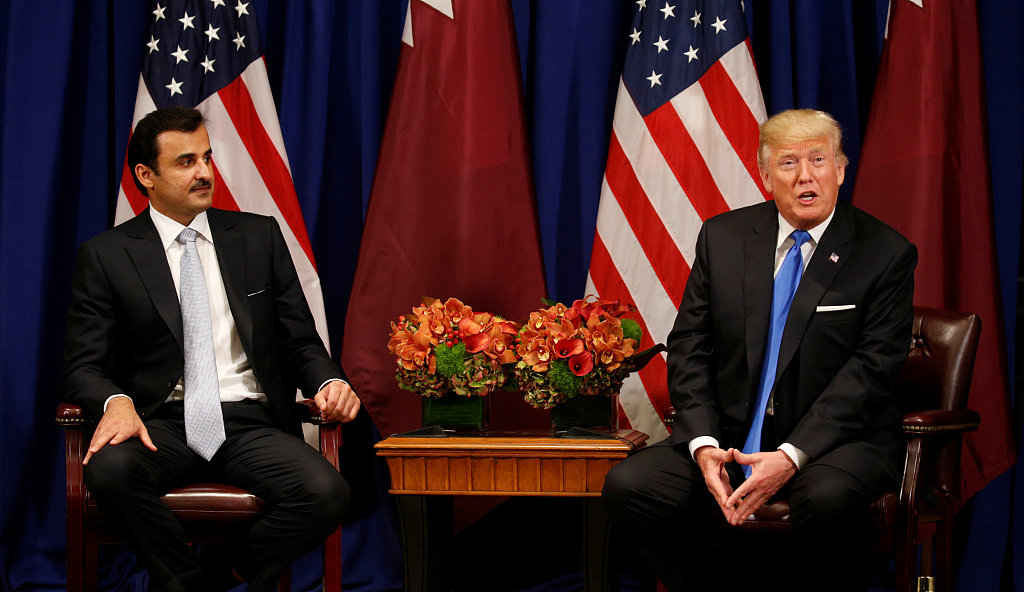
U.S. President Donald Trump meets with Qatar's Emir Sheikh Tamim bin Hamad al-Thani in New York, U.S., September 19, 2017. /VCG Photo
Terror financing?
Saudi Arabia, the United Arab Emirates (UAE) and Bahrain, who, along with Qatar are members of the Gulf Cooperation Council, plus non-GCC member Egypt, cut off diplomatic, travel and trade ties with Qatar in June of 2017, accusing it of supporting terrorism.
Qatar denies the charges and says their move is aimed at curtailing its sovereignty.
Read more:
2017 News Map: The Gulf plunges into crisis as countries cut ties with Qatar
Qatar responses to Saudi-led demands
Trump offers to mediate Qatar crisis
Five Arab countries cut ties with Qatar for ‘supporting terrorism’
Although Washington offered to mediate, no productive outcomes have been worked out.
Trump himself had also called on Qatar to stop funding groups that commit terrorism, saying the Gulf nation had historically done so "at a very high level."
Qatar is accused by some countries of acting as a major funder of Hamas and the Muslim Brotherhood. The two organizations were both designated as terrorist organizations by the Trump administration.
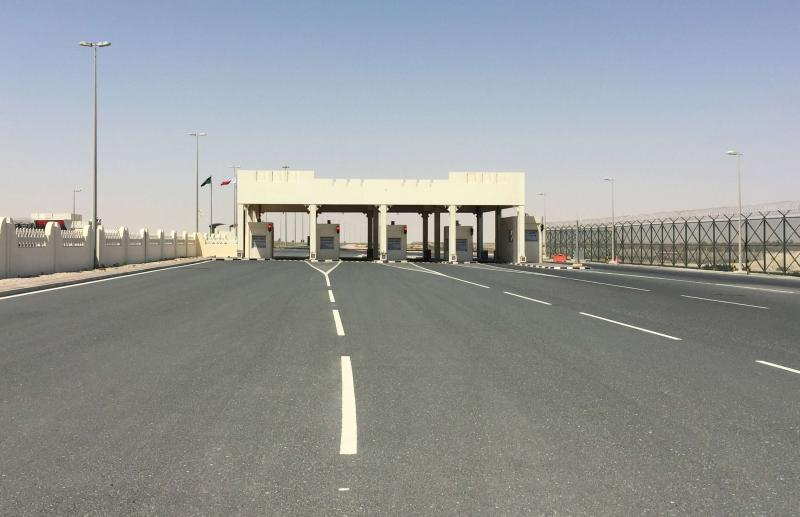
The Abu Samra border crossing to Saudi Arabia in Qatar, June 12, 2017. /Reuters Photo
Triangle drama
Qatar has meanwhile maintained cordial relations with Tehran amid Trump's "maximum pressure" campaign against Iran.
On the one hand, the U.S. deployed F-22 stealth fighters to Qatar for the first time last month, showing the escalating standoff between the U.S. and Iran after Iran shot down a U.S. drone over sensitive Gulf waters last month.
Read more:
Trump says he halted U.S. strike on Iran over possible casualties
What comes next as tensions mount high between U.S., Iran?
On the other hand, Qatar is moving closer to Iran as it has been using Iran's airspace and shipping routes to circumvent the Arab countries' blockade.
Following June's phone call between the Qatari emir and Iran's President Hassan Rouhani, they jointly voiced a will to further develop ties, saying the two good neighbors shared close views on many regional issues.
After a spike of tensions between Saudi Arabia and Iran, leaders from members of the Arab League, the Organization of Islamic Cooperation and Gulf Cooperation Council held emergency summits in May, concluding with a joint statement accusing Iran of escalating tensions.
Qatar, who attended summits, later claimed the statement was made without their input and thus does not reflect Doha's foreign policy.
It is unclear if Qatar will finally have to pick a side.
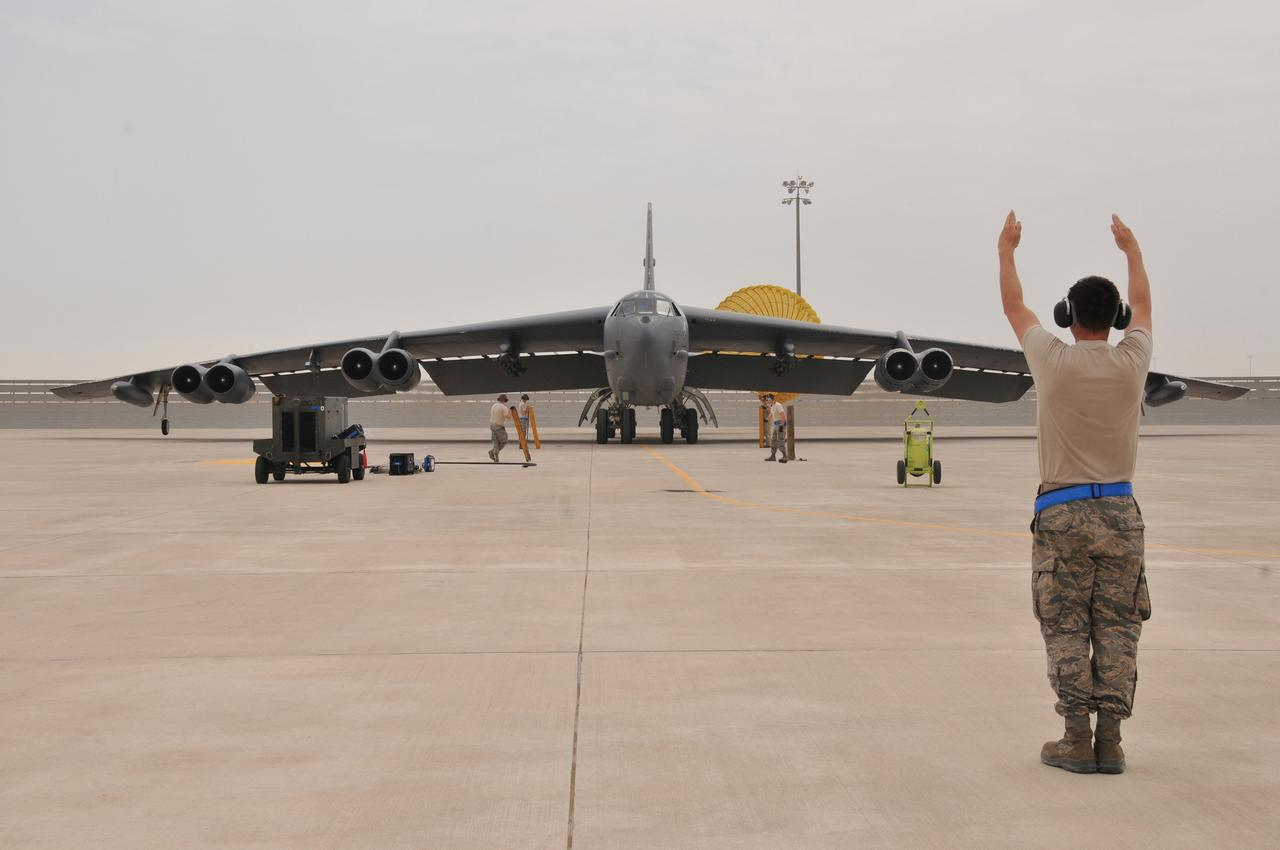
A U.S. Air Force B-52 Stratofortress bomber arrives at Al Udeid Air Base, Qatar April 9, 2016. /Reuters Photo
Stance on Israel-Palestine conflict
Qatar on Monday, during the general debate of the 41st session of the UN Human Rights Council and stressed its firm support to the Palestinian people and their right to establish an independent state based on the borders of 1967, with East Jerusalem as its capital.
In this case, Qatar cannot be a big fan of the U.S.-proposed "Deal of the Century", a blue print driven by Trump's son-in law and White House adviser Jared Kushner aimed at finishing off the Israel-Palestine decades-long conflicts.
Based on several leaks, the core of the deal could be seen as offering Palestine the money needed for improving the humanitarian situation in return for Palestinians abandoning both East Jerusalem as the capital of their future state and their right of return, as enshrined in international law.
Read more:
Delayed and delayed: Where is Trump's 'Deal of the Century'?
For the June 25-26 Bahrain conference organized by the U.S., which aimed to explain the economic part of the "Deal of the Century", Qatar didn't send a high-level delegation.
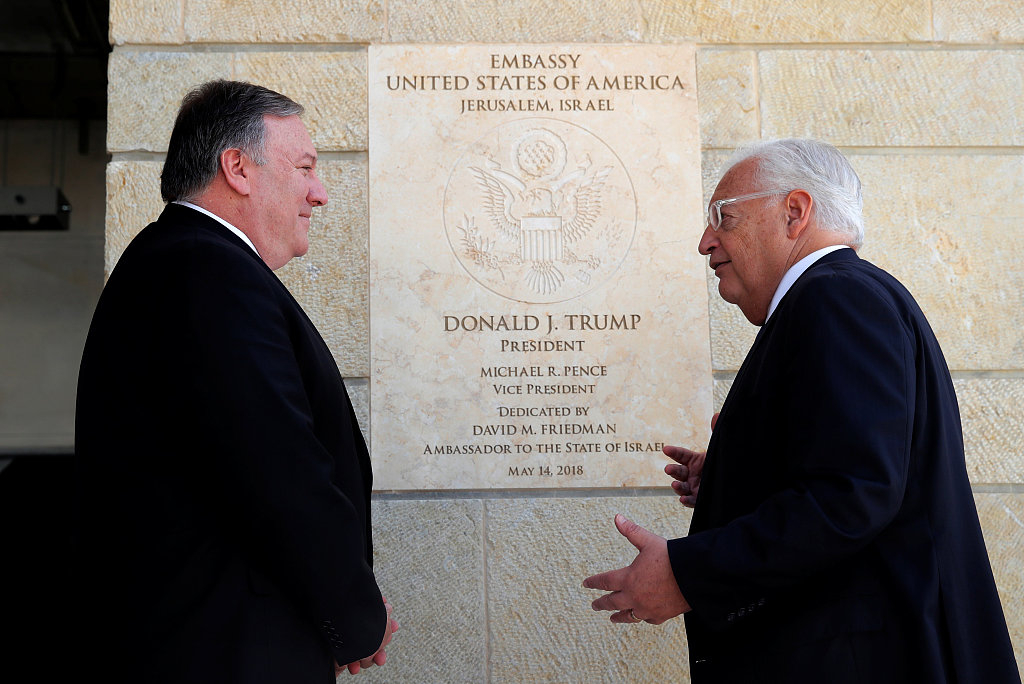
U.S. Secretary of State Mike Pompeo and U.S. Ambassador to Israel David Friedman stand next to the dedication plaque at the U.S. embassy in Jerusalem, March 21, 2019. /VCG Photo
After Trump announced his decisions in 2017 to recognize Jerusalem as Israel's capital and move the U.S. embassy there from Tel Aviv, Qatar also denounced Trump's move.
When speaking to reporters in early June, the Qatar foreign minister Sheikh Mohammed bin Abdulrahman al-Thani said: "As far as we see, right now there is a disconnect between the Palestinians and the U.S."
"Our position remains very firm, we are going to support any plan that the Palestinians are willing to accept," he added.
(With input from agencies)