- Home
- China
- World
- Asia-Pacific
- Americas
- Europe
- Middle-East and Africa
- Politics
- Business
- Opinions
- Tech & Sci
- Culture
- Sports
- Travel
- Nature
- Picture
- Video
- Live
- TV
- Specials
- Learn Chinese


Share







Copied
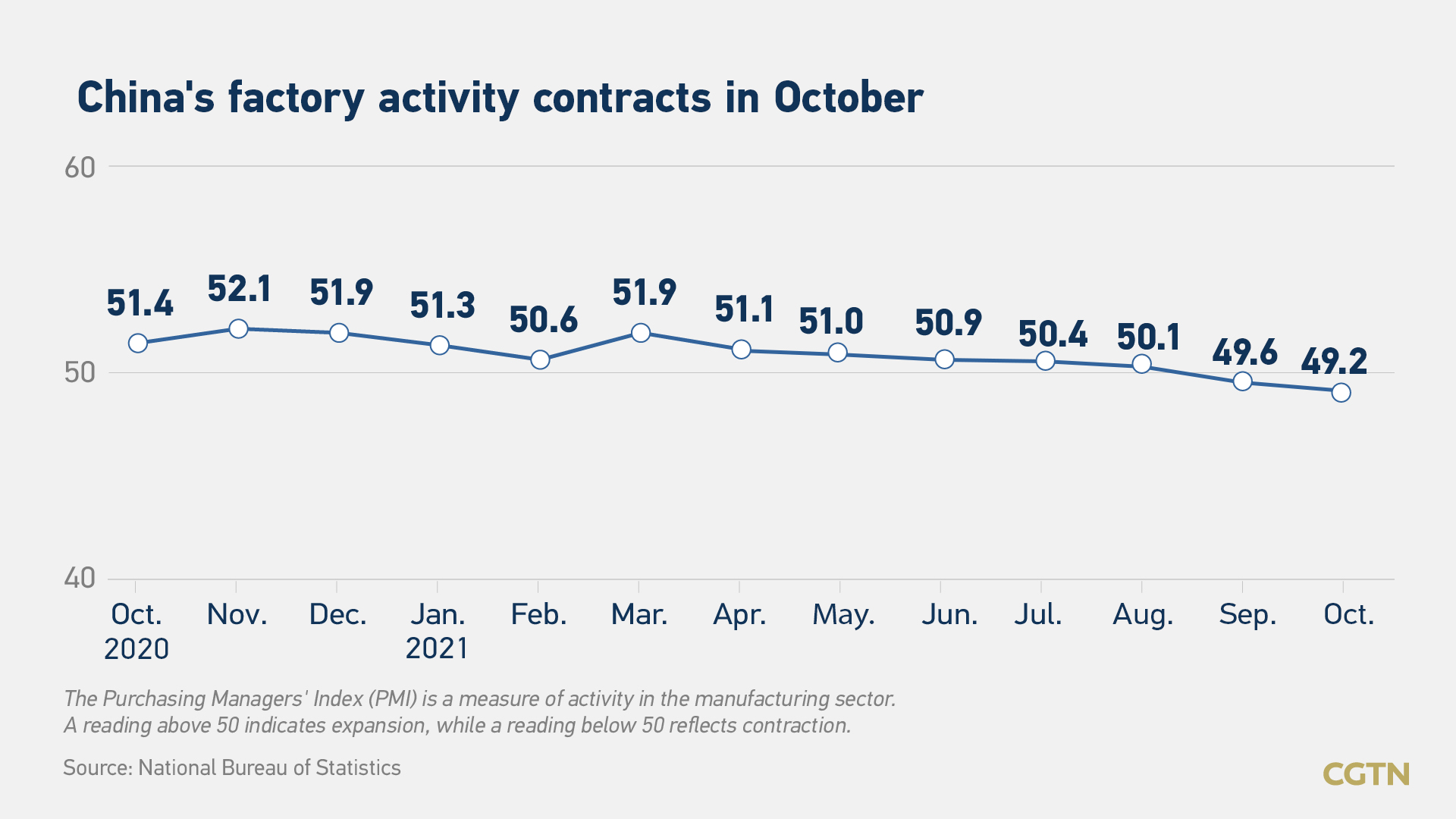
China's factory activities shrank for a second month as a power crunch and high raw material prices continued to weigh on production, while service secured a slow growth.
The official manufacturing Purchasing Managers' Index (PMI) slipped to 49.2 in October, the second contraction since February 2020 after 49.6 in September, data from the National Bureau of Statistics (NBS) showed on Saturday.
"The factory gate price index reached a multi-year high," Zhao Qinghe, a senior statistician with the NBS, said in an accompanying statement. Zhao said the price of raw materials accelerated growth as the price index for sectors including petroleum, coal and other fuel processing soared above 73 percent.
The purchase price index and factory gate price index of major raw materials rose a monthly 8.6 and 4.7 percentage points respectively, hitting 72.1 percent and 61.1 percent, NBS data showed.
The production index and the new order index were 48.4 percent and 48.8 percent, respectively, down 1.1 and 0.5 percentage points from September, indicating a slowdown of manufacturing activities and market demand.
The raw material inventory index edged down 1.2 percentage points from September, revealing that the manufacturing industry's inventory of major raw materials continued to decrease. Data also showed that the delivery time of manufacturing raw material from suppliers continued to extend as the delivery time index further slipped to 46.7 percent.
The manufacturing PMI figure stayed in the contraction territory and missed economists' estimates of 49.7 as polled by Reuters.
China's services recorded a slight expansion. The official non-manufacturing PMI stood at 52.4 in October, down 0.8 percentage points from 53.2 in September, as some sporadic COVID-19 outbreaks interrupted the service sector's ability to bounce back.
The official October composite PMI, which includes both manufacturing and services activity, stood at 50.8, down from September's 51.7.
A reading above 50 indicates expansion in activities, while a reading below that mark reflects contraction.
The October readings show increasing downturn pressure with expectation for rising prices, Bank of Communications Research Center said in a note on Sunday.
Looking forward to November, the manufacturing PMI could remain weak due to shocks from both supply and demand sides and the non-manufacturing PMI could continue to drop due to the new cases of COVID-19, Lu Ting, Nomura Chief China Economist, said in a note on Sunday.
China has moved to bring down prices for raw materials by boosting supply and pledged to continue to take measures to prevent the increase in commodity prices from being transmitted downstream in the supply chain.
Read more: China strengthens financial support for coal, electricity production
