- Home
- China
- World
- Asia-Pacific
- Americas
- Europe
- Middle-East and Africa
- Politics
- Business
- Opinions
- Tech & Sci
- Culture
- Sports
- Travel
- Nature
- Picture
- Video
- Live
- TV
- Specials
- Learn Chinese


Share







Copied
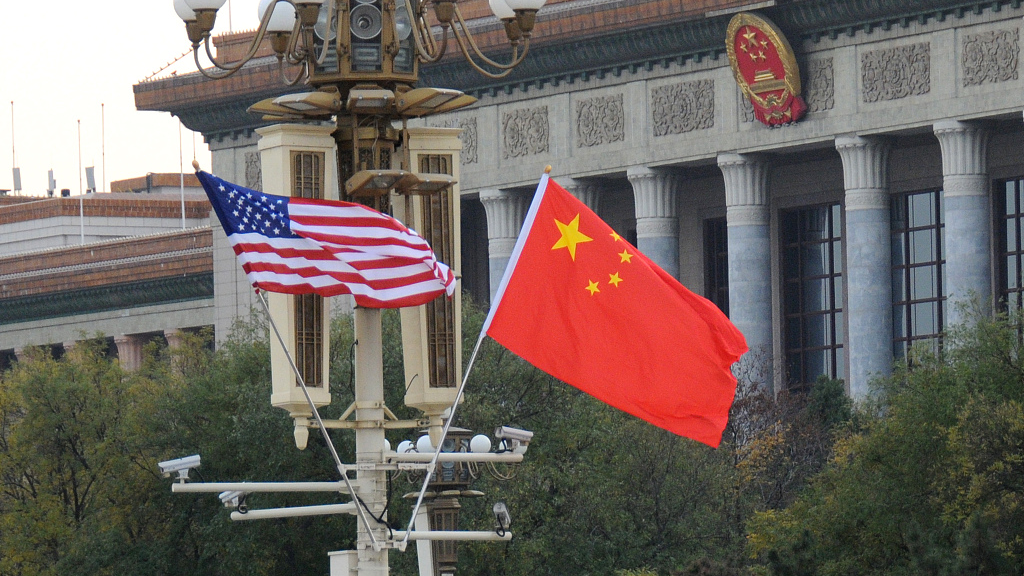
As an ancient Chinese saying goes, "A long journey can be covered only by taking one step at a time." The upcoming China-U.S. summit on Tuesday morning, which is the first virtual meeting between Chinese President Xi Jinping and his U.S. counterpart Joe Biden, could be another step worth marking.
Given the helmsmanship of the two heads of state plays a key role in steering bilateral relations, people are eager to see whether the Xi-Biden summit will help break new ground to prevent China-U.S. relations from spiraling toward conflict.
The steps along the road
Biden's interaction with Xi can be traced back to the year 2011 when the then U.S. vice president was on his third visit to China. Xi, then the Chinese vice president, characterized Biden's six-day visit as a big event in China-U.S. relations that year, saying the visit will boost bilateral cooperative partnership.
The talks marked the second interaction between Xi and Biden, as they also met on the sidelines of the celebrations of Italy's 150th anniversary of unification in Rome in June that year.
During the China visit, Biden delivered a 50-minute speech at Sichuan University, saying that "with good relations with China, the two countries can work together, to meet the challenges of the world, and benefit two peoples of the two countries."
Biden and Xi met at least eight times in the United States and China in the 18 months beginning in early 2011 and held formal meetings, walked together and ate together for over 25 hours, accompanied only by an interpreter, the New York Times reported, citing former U.S. officials.
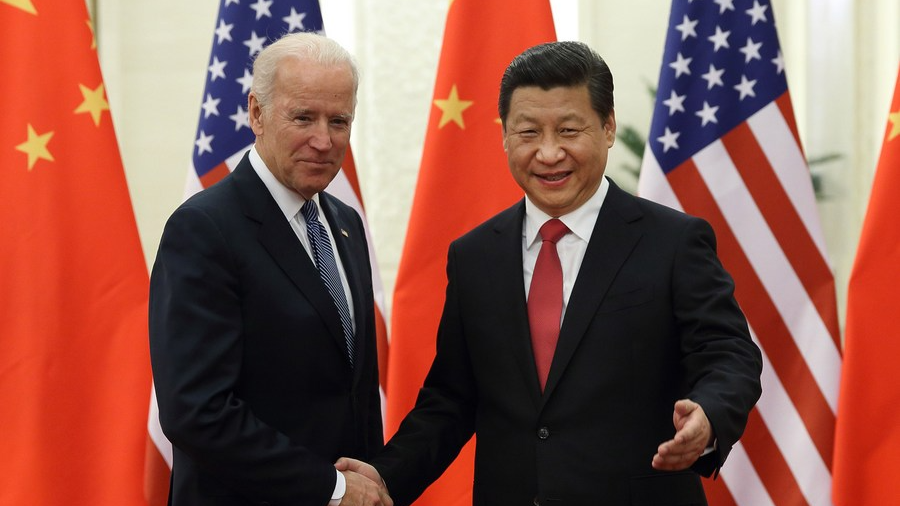
Chinese President Xi Jinping (R) shakes hands with Joe Biden, U.S. vice president, during their meeting at the Great Hall of the People in Beijing, capital of China, December 4, 2013. /Xinhua
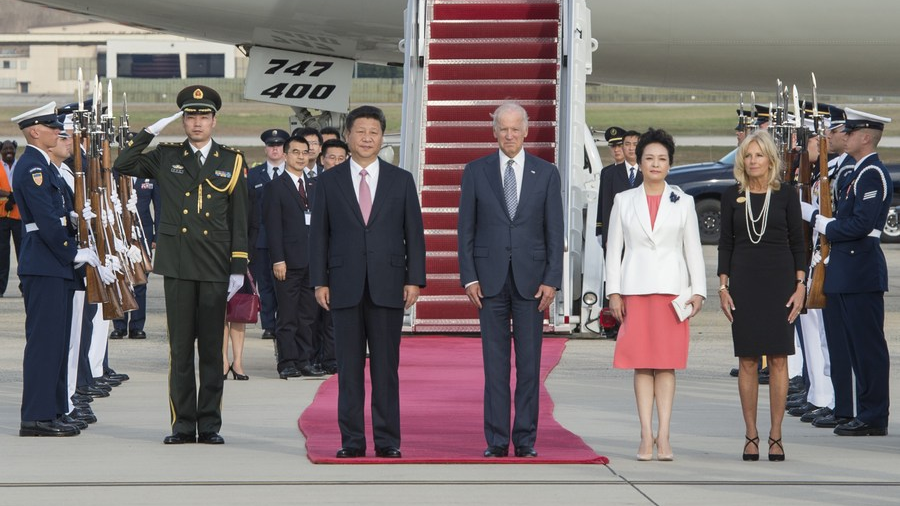
Chinese President Xi Jinping and his wife Peng Liyuan are welcomed by Joe Biden, U.S. vice president, and his wife at Andrews Air Force Base in Washington, D.C., U.S., September 24, 2015. /Xinhua
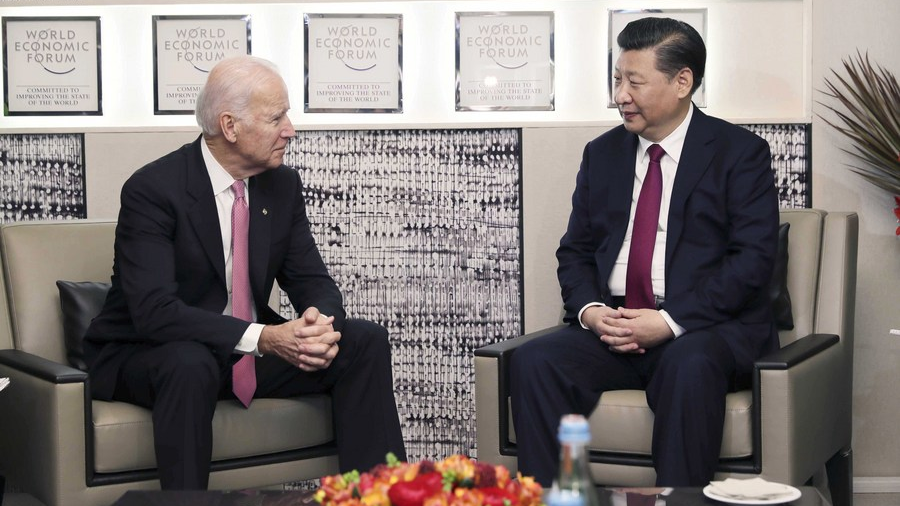
Chinese President Xi Jinping (R) meets with Joe Biden, U.S. vice president, in Davos, Switzerland, January 17, 2017. /Xinhua
In 2013, Biden had his second visit to China as vice president and held talks with Xi, who was elected Chinese president in March the same year. The two leaders agreed to step up dialogue, exchanges and cooperation to advance the building of a new model of major-country relationship.
During his first state visit to the U.S. in 2015, Xi attended a welcome luncheon co-hosted by then Vice President Biden and then Secretary of State John Kerry of the U.S.
"Although there are some differences, still they are all resolvable. There are also competitions, but they represent a healthy relation in which the two sides can learn from each other and achieve common development," Biden said, adding that the two states enjoy substantial common interests.
Last year, Xi congratulated Biden on election as U.S. president in a message, highlighting the spirit of non-conflict, non-confrontation, mutual respect and win-win cooperation in advancing bilateral ties.
Since the beginning of this year, Xi has held two phone conversations with Biden – the first came 22 days after Biden's inauguration on the eve of the Chinese New Year and the second on September 10, seven months after their first call.
One month after that, China's Foreign Ministry announced the two sides discussed holding a video summit between their leaders by the end of the year, saying that the summit will be an implementation of the important consensuses reached by the two leaders during the phone call on September 10, when they agreed to maintain close contact in multiple forms.
The latest crossover between the two leaders came about a week ago when Xi and Biden sent congratulatory messages to the 2021 Gala Dinner of the National Committee on U.S.-China Relations, which was read out respectively by Chinese Ambassador to the U.S. Qin Gang and Chairman of the National Committee Jacob Lew.
Both stressed that the relationship between the two sides has global significance.
The manner and frequency of the interaction between the two leaders have signaled a positive sign, said Ruan Zongze, executive vice president and senior research fellow of the China Institute of International Studies, in an interview with China Media Group on Saturday.
The way ahead
This year, in addition to the two direct interactions between the two leaders, China and the United States also conducted several high-level exchanges with focus on climate change, trade and some important and sensitive issues involving Taiwan, Hong Kong and the South China Sea.
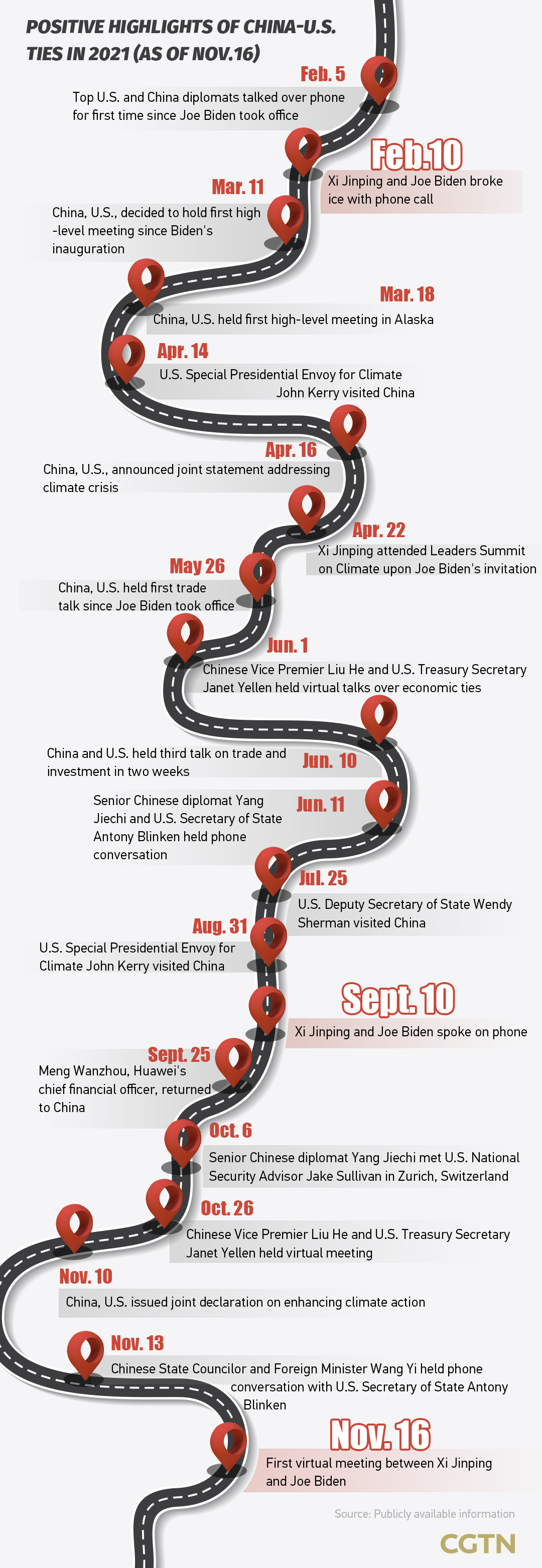
For instance, China and the U.S. held three talks on trade and investment in two weeks, U.S. Special Presidential Envoy for Climate John Kerry visited China twice and the "sacred and inviolable" sovereignty and territorial integrity of China were almost emphasized every time by the Chinese side during other China-U.S. high-level meetings.
Even less than a week before the Xi-Biden summit, Taiwan question was a flash point in bilateral ties – China warned the U.S. last week to take concrete actions, abide by the one-China principle and stop sending erroneous signals to "Taiwan independence" forces.
The warning came after the U.S. Secretary of State Antony Blinken's recent remarks on the U.S.'s commitment to ensuring Taiwan's ability to defend itself.
How to put China-U.S. relations back on the right track will be the biggest focus of the upcoming summit, said Ruan, noting a negative China policy after the Biden administration took office.
In April, the U.S.'s "Strategic Competition Act of 2021" drew a hardline legislative blueprint framing Beijing as a "political, diplomatic, economic, military and ideological power," and a strategic competitor to the U.S.
In July, China delivered two lists of major concerns to the U.S. when Vice Foreign Minister Xie Feng met with U.S. Deputy Secretary of State Wendy Sherman, urging the U.S. to change its misguided mindset toward China and its extremely risky China policy.
In a preparatory phone call with Blinken for the summit on Saturday, Chinese Foreign Minister Wang Yi stressed that the two sides should "work in the same direction and make every preparation" to bring bilateral relations back onto the track of sound and steady development.
While the trajectory of the relationship is unlikely to change significantly in the short term, there is optimism for re-establishing cooperation in certain areas, especially climate.
At the 2021 United Nations Climate Change Conference that concluded on Saturday, China and the U.S. issued the Joint Glasgow Declaration on Enhancing Climate Action in the 2020s, demonstrating that in climate change, consensus outweighs differences between the two sides, and the two countries have broad potentials for cooperation.
