- Home
- China
- World
- Asia-Pacific
- Americas
- Europe
- Middle-East and Africa
- Politics
- Business
- Opinions
- Tech & Sci
- Culture
- Sports
- Travel
- Nature
- Picture
- Video
- Live
- TV
- Radio
- Specials
- Learn Chinese


Share







Copied
Newly elected Pakistani Prime Minister Shahbaz Sharif is out and about governing the country with his signature agility seen during his days as the provincial chief of Punjab while former Prime Minister Imran Khan is staging power shows to pressure the government into early elections, still alleging foreign involvement in the country's regime change.
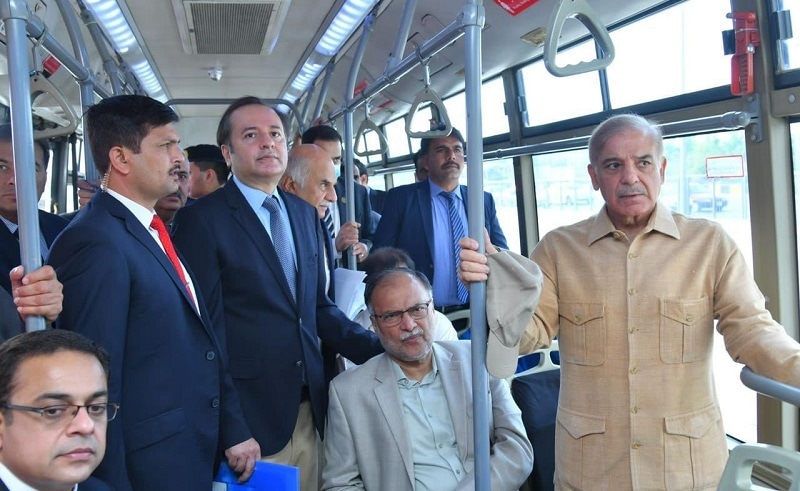
Prime Minister Shahbaz Sharif (R) is seen in a Metro bus during an inspection visit in Islamabad, Pakistan, April 14, 2022. /courtesy of PMO
Respecting Pakistan's democratic process, a number of countries, including China, Russia, the U.S., the UK, UAE, Saudi Arabia, Germany and India, have congratulated Sharif on his new position, vowing to work together with the new leadership.
Given the warm response, outlook of Pakistan's international relations looks positive as global leaders have chosen to focus on bilateral ties with the country as a whole than indulging in who runs it.
However, things are not that rosy on the domestic front as the country faces a multitude of political, institutional and economic challenges while the former ruling party continues to question the legitimacy of the new government in the "court of the people."
Political challenges
After Khan's ouster with a no-confidence vote in the National Assembly, the primary premise of his party Pakistan Tehrik-e-Insaaf (PTI) for resigning en masse from the parliament and staging protests across the country has been that the power change was allegedly orchestrated by the U.S. – a claim that the U.S. denies.
Citing a cable as "proof," first brandished but not declassified at a rally on March 27, Khan has been claiming that the U.S. had allegedly made threats via Pakistani ambassador about having him replaced. He claims that it was his pursuit of an "independent foreign policy" and saying "absolutely not" to an alleged U.S. demand for Pakistan's military bases that didn't sit well with the U.S.
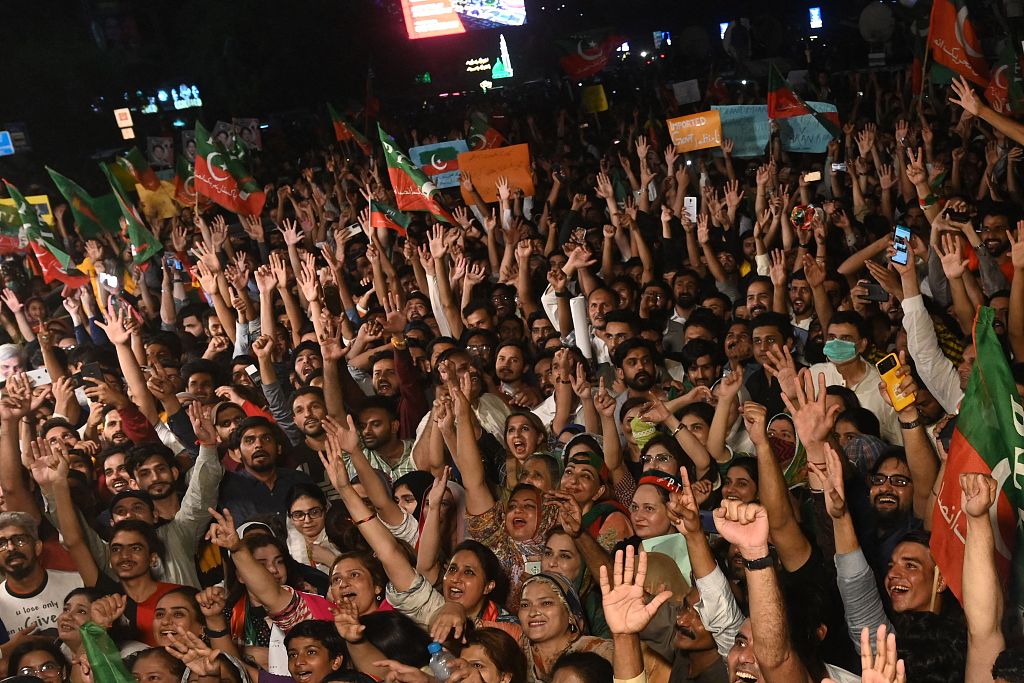
Supporters of former Pakistani Prime Minister Imran Khan protest against his ouster, Lahore, Pakistan, April 10, 2022. /CFP
However, what Khan claimed to be a "conspiracy" to oust his government was labelled by the country's National Security Committee as "interference" and usage of "undiplomatic language" for which a "strong demarche" was issued to the U.S. after a high-profile meeting on March 31, as suggested by Inter-Services Public Relations Director General Major General Babar Iftikhar in a press conference on April 14.
As of military bases, Iftikhar said the army would have adopted the same stance as Khan's, but the U.S. never asked for the bases – Khan's refusal was only in response to a hypothetical question asked during a media interview last year.
This should have cleared the air and set the tone for Pakistan to move on after a spell of not-so-clean politics that saw parliamentarians unceremoniously shifting loyalties, the government invoking the top court's ire for "unconstitutionally" trashing the no-confidence vote and taking a series of actions including the assembly's dissolution that were later set aside, an unamicable exit for Khan and PTI's resignations that have left a good chunk of the parliament empty.
However, in a mindboggling development, the DG ISPR's remarks were taken by both the government allies and the PTI as a confirmation of their opposing claims, and clash continues till date. The PTI demands early elections and continues to rally masses until the demand is met.
Political conflict and street protests are not the only thing keeping government on its toes as the prime minister also faces the challenge of pulling off a tough balancing act of keeping its allies together whose critical votes helped oust Khan and arranging by-elections on the seats left vacant by PTI members.
After a weeklong delay, a federal cabinet is expected to be announced today (April 18), according to Dawn newspaper, and "all allied parties were being accommodated."
Pakistan Muslim League-Nawaz (PML-N) would get 14 ministries while 11 have been kept for Pakistan People's Party (PPP), Dawn quoted PML-N spokesperson Marriyum Aurangzeb, who is likely to become information minister.
Institutional challenges
Whenever there is talk of government change in Pakistan, the fears of non-political institutions interfering in the political process crop up as a segment of political actors attempt to create conditions which invoke the use of judicial or military action.
The Supreme Court walked a tight rope by stepping in over a constitutional violation by the deputy speaker in the National Assembly – a move detested by some for alleged interference in parliamentary proceedings but accepted by all.
Moreover, soon after Khan hit the streets, a "propaganda campaign" surfaced to smear the army. Chief of Army Staff (COAS) General Qamar Javed Bajwa, who has maintained due neutrality in the entire political process, stressed on April 17 that misinformation and propaganda threatened state's integrity and required timely and unified response, according to the Express Tribune.
It remains a challenge for the institutions to exercise restrain and remain within their jurisdiction as the country tackles cases like insinuations by former law minister to create civil unrest and violence in the provincial assembly over the election for Punjab chief – Sharif's son Hamza Shahbaz was elected the chief minister on April 16 in a session marred by attacks on deputy speaker as well as the contending veteran politician Chaudhry Parvez Elahi after which anti-riots police had to be called in.
Economic challenges
Moreover, inflation and current account deficit are two major economic challenges facing Pakistan as masses look up to the new government to provide some relief.
Pakistan's current account deficit is projected at around 4 percent of GDP for the 2022 fiscal year, Reuters reported citing the central bank, while foreign reserves had dropped to $11.3 billion as of April 1.
Earlier this month, the central bank also increased key interest rates by 250 basis points to 12.25 percent, the biggest hike in decades, citing deterioration in the outlook for inflation and an increase in risks to external stability, heightened by the Russia-Ukraine conflict, as well as local political uncertainty, according to Reuters.
Facing pressure from the masses, Sharif on April 15 rejected a proposal for an unprecedented hike in the prices of petroleum products. The people of the country would "curse" the new government if such a "mountain of inflation" was unleashed on them, Dawn quoted Sharif as saying.
An imminent hike in petroleum prices may have been averted but what about other areas like commodity prices and power crisis? Will Sharif be able to survive till August next year or will he succumb to the challenges and call early elections? It remains to be seen if the new government will take actions keeping in mind the long-term benefit of the country or resort to quick-fixes to gather support for the next elections, whenever they are held.
