- Home
- China
- World
- Asia-Pacific
- Americas
- Europe
- Middle-East and Africa
- Politics
- Business
- Opinions
- Tech & Sci
- Culture
- Sports
- Travel
- Nature
- Picture
- Video
- Live
- TV
- Documentary
- Radio
- Specials
- Learn Chinese


Share







Copied
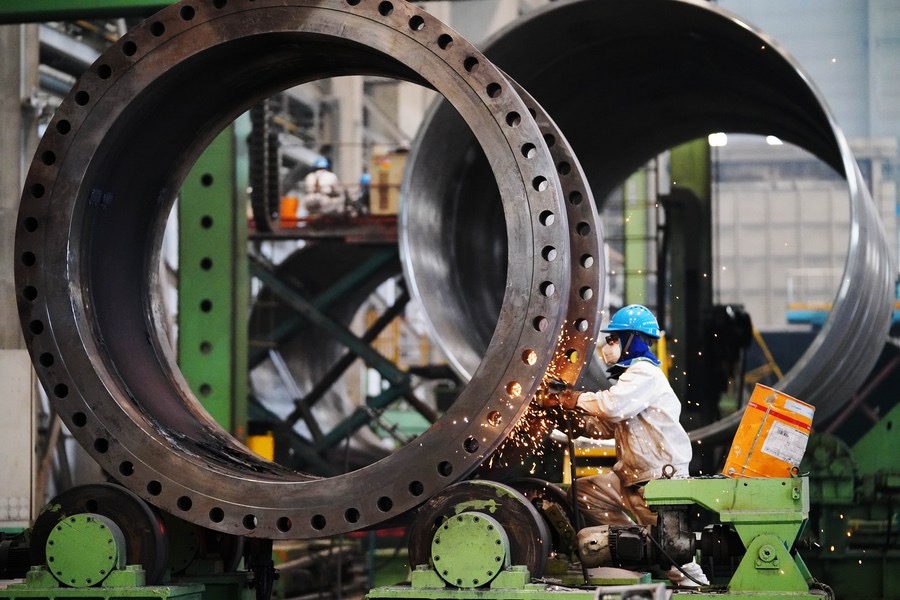
A worker operates at a factory of Harbin Boiler Co., Ltd. of Harbin Electric Corporation in Harbin in northeast China's Heilongjiang Province, April 14, 2022. /Xinhua
The global factory activity slowed down in June on a toxic mix of the Russia-Ukraine conflict, inflation pressure and the pandemic, data from the China Federation of Logistics and Purchasing (CFLP) showed on Wednesday.
The June global manufacturing Purchasing Managers' Index (PMI) fell to the lowest in the year to 52.3, dropping 1.2 percentage points from May, CFLP data showed.
In terms of regions, June manufacturing PMI increased slightly in Asia from the previous month. However, the index declined around 2 percentage points across Europe, America and Africa, indicating a weakening of economic recovery.
Asian June manufacturing PMI came in at 51.4, an increase for 2 consecutive months, indicating relatively stable growth in the region.
Notably, China's June Caixin manufacturing PMI rose to 51.7, the highest reading in 13 months as production quickly recovers.
CFLP cautioned that many Asian countries are mired in uncertainties with the high inflation coupled with low growth. Inflation rates are rising rapidly in countries such as South Korea, the Philippines and Thailand, driven by rising oil and food prices.
The European manufacturing PMI declined for five consecutive months to 52.4 in June. The European economy is under considerable pressure because of energy shock, the pandemic and labor shortages, the CFLP said in a report.
While economic growth is slowing, inflation soared in Europe. Eurozone inflation hit a record high in June at 8.6 percent, official data showed.
The American manufacturing PMI dropped to 53.2 in June, among which, the U.S. manufacturing PMI edged down 3.1 percentage points from the previous month to 53. The U.S. new orders index fell nearly 6 percentage points, indicating a significant walk back in demand from May.
The U.S. stagflation pressure is gradually adding up as the country raises interest rates to tame inflation, the CFLP said.
The U.S. federal reserve started to raise interest rates off zero in March to combat price surges. It hiked rates by 0.75 percentage points in June, the biggest increase in 28 years. The hawkish stance fuels recession fears. In the latest report, Bloomberg economists see a 38 percent chance of a U.S. recession in the next 12 months.
The World Bank slashed its 2022 global growth forecast to 2.9 percent as the Russia-Ukraine conflict and COVID-19 pandemic weigh on growth. The bank also warned of the elevated risk of global stagflation.
(Xu Beibei contributed to this story)
