POLITICS


Analysis: How far can DPRK's missiles hit?
2017-04-16 20:12 GMT+8






Editor
Wang Lei
By CGTN's Wang Lei
The Democratic People's Republic of Korea (DPRK) conducted a failed ballistic missile test on Sunday morning, according to American and South Korean military officials.
The launch came one day after a massive military parade in Pyongyang, during which what appeared to be a new intercontinental ballistic missile (ICBM) was displayed. However, some experts believe the country's ICBMs are still under research and development, given that it has never flight-tested an ICBM capable of crossing the Pacific.
The question is: How far can its missiles really go and can they hit American soil?
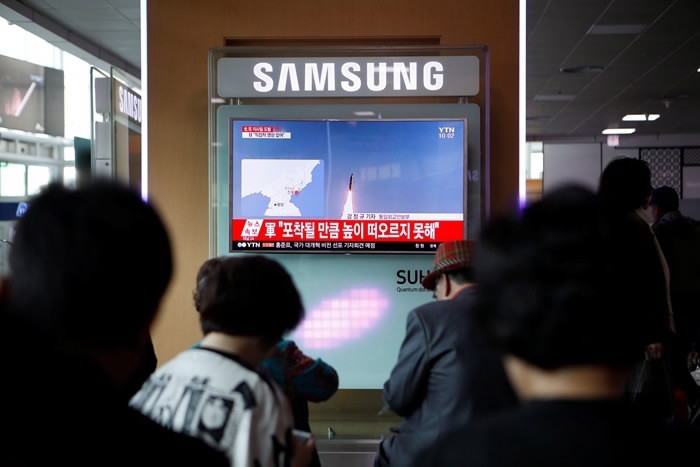
People at a railway station in Seoul watch a TV broadcasting a news report on the DPRK's failed missile launch on April 16, 2017. /VCG Photo
Failed show of strength?
DPRK leader Kim Jong Un said in his New Year address on January 1 that his country was making final preparations to conduct its first ICBM test, without providing more details.
Since Donald Trump became the president of the United States in late January, the world's most powerful nation has repeatedly threatened to stop the DPRK from advancing its missile and nuclear programs, while Pyongyang refuses to give in, conducting a series of weapon tests this year.
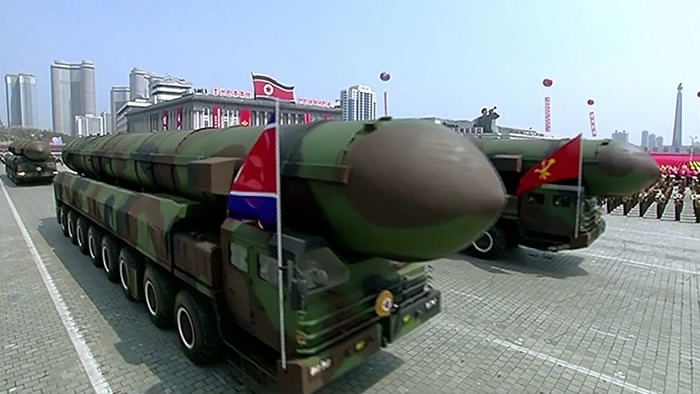
The DPRK holds a military parade in Pyongyang on April 15, 2017.
Amid soaring tensions on the Korean Peninsula, Pyongyang staged an immense parade on Saturday, the 105th anniversary of the birth of Kim Il Sung, founder of the DPRK and the grandfather of Kim Jong Un. Submarine-launched ballistic missiles were displayed for the first time, along with what analysts said could be a new type of ICBM.
"It's presumed to be a new ICBM. It seems longer than the existing KN-08 or KN-14 ICBMs," a South Korean military official told Yonhap.
Judging from the size of the canister, South Korean military expert Shin In-kyun said it might contain "a new ballistic missile with a range of 6,000 kilometers."
The DPRK holds a military parade in Pyongyang on April 15, 2017.
However, whether the missiles inside the huge canisters were completed was not clear. Even if the DPRK does have ICBMs, their maturity and effectiveness in war have not been tested.
"At present, I don't think the DPRK has gained the technology to produce a long-range or even intercontinental ballistic missile," Zhang Junshe, vice president of the China Naval Research Institute, said during an interview with CGTN, stressing the country's lack of success in previous missile tests.
He believes the DPRK does not pose a direct threat to the US at the moment.
While the world was wondering whether the DPRK has made a significant breakthrough in its missile technology, the country fired an unidentified missile the next morning, but it appeared to have failed.
The DPRK conducts a failed missile test on April 16, 2017.
"The launch of the ballistic missile occurred near Sinpo. The missile blew up almost immediately," Dave Benham, a spokesman for the US Pacific command, said of the test by the DPRK near its east coast. Benham added that the type of missile involved is being assessed.
An official of the South Korean Joint Chiefs of Staff also said the launch "ended in failure" as the missile "exploded right after lift-off," according to the Yonhap news agency.
The failure was "a deep embarrassment" for Kim Jong Un, who attempted to flex his muscles as American warships approached his country, according to a report in The New York Times.
Does the DPRK possess formidable ICBMs? Its show of strength during this weekend was far from convincing.

Soldiers of the DPRK march and shout slogans during a military parade in Pyongyang on April 15, 2017. /VCG Photo
Incapable, but determined
The DPRK has been developing missiles with increasing ranges during the past decades. After successful tests of various types of short- and medium-range ballistic missiles in the 1980s and 90s, experts believe the country could reliably target the Republic of Korea (ROK), Japan and possibly US military bases on Guam, but not the American mainland – yet. It would need a missile with a range of about 10,000 kilometers to hit the American mainland, excluding Alaska and Hawaii, which are about 5,500 and 7,500 kilometers away from the DPRK respectively.
The range of an ICBM is above 5,500 kilometers, according to the Federation of American Sciences. So if the DPRK mastered sophisticated ICBM technology, it would pose a practical threat to the US, leading to unpredictable consequences. That is why the country's military parades and missile tests have been closely watched around the globe.
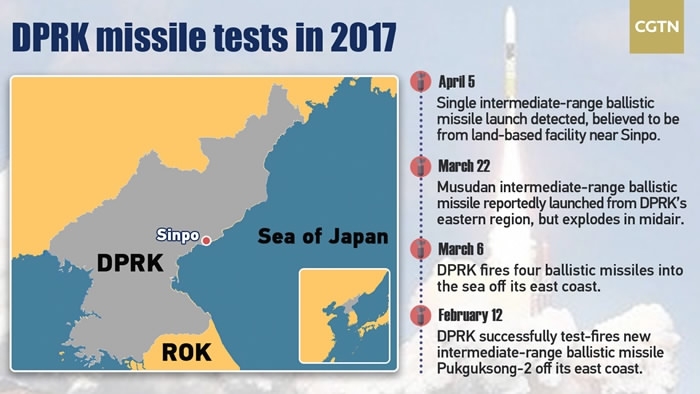
The DPRK's previous missile tests in 2017. /CGTN Graphic
Though the DPRK appeared to have presented different types of ICBMs in its parades, no one knows how far they can reach until they are tested. Compared with parades, missile and rocket tests are better indicators of the country's real capabilities.
According to reports on American and South Korean media, many of the DPRK's tests were either unsuccessful or short of expectations. Even the DPRK itself conceded failure after a slightly modified Unha-3 rocket exploded during a test in April 2012.
The maximum distance a DPRK missile or rocket has flown in a test was no more than 4,000 kilometers, according to the Pentagon. With that range, a missile would not qualify for an ICBM.
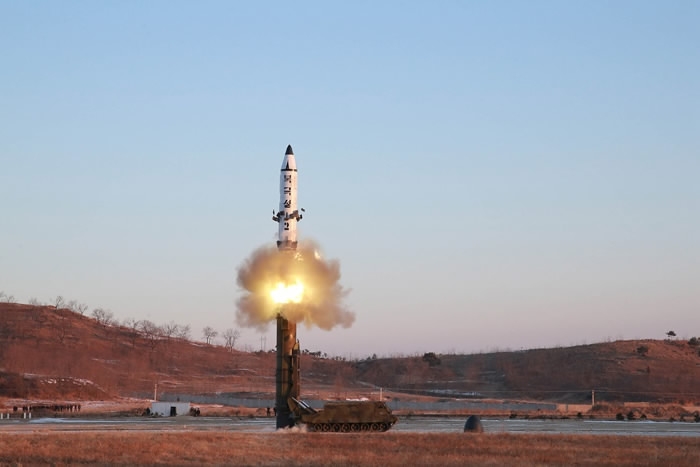
The DPRK test-fires new intermediate range ballistic missile Pukguksong-2 on February 12, 2017. /VCG Photo
The DPRK test-fired a Taepodong-2 missile on July 5, 2006. The missile could reach a range of 3,500 kilometers in theory, but the US said it had dropped into the Sea of Japan 35 seconds after launch.
On April 5, 2009, the DPRK claimed it had successfully launched three-stage Unha-2 rockets carrying a satellite, while Washington said it had failed. Later analysis indicated the rocket traveled about 3,800 kilometers before landing in the Pacific Ocean east of Japan.
The country launched a succession of rockets and ballistic missiles afterwards, but none proved to have reached longer distances. Nevertheless, it claimed to have successfully put a satellite into orbit with long-range rocket Kwangmyongsong-4 in February last year, which could mean a breakthrough in its ICBM technology, given the similarity between rockets and ICBMs.

DPRK leader Kim Jong Un attends a military parade in Pyongyang on April 15, 2017. /VCG Photo
So far, there is no solid evidence to prove the DPRK has the ability to hit the US with ICBMs, despite the progress it has made. However, Kim Jong Un showed Trump his determination to continue with the program by displaying probably immature missiles in the latest parade.
"Tests of the weapons platforms failed before," Teng Jianqun, a senior US studies researcher at the China Institute of International Studies, told Phoenix TV. "Despite their immaturity, they were displayed anyway. I think it went beyond weapons themselves – it was not just a show of weapons." Teng stressed the DPRK leader had shown his strong political will and readiness to engage in a long fight.
It remains to be seen when and how Trump will "take care of" Kim's determination. Although military confrontation is in no one's interest, the stakes are dangerously high.
Related stories:
Copyright © 2017
SHARE
- EXPLORE
- MORE
FOLLOW US